How Much Does Direct Mail Cost? Direct Mail Pricing & ROI Guide
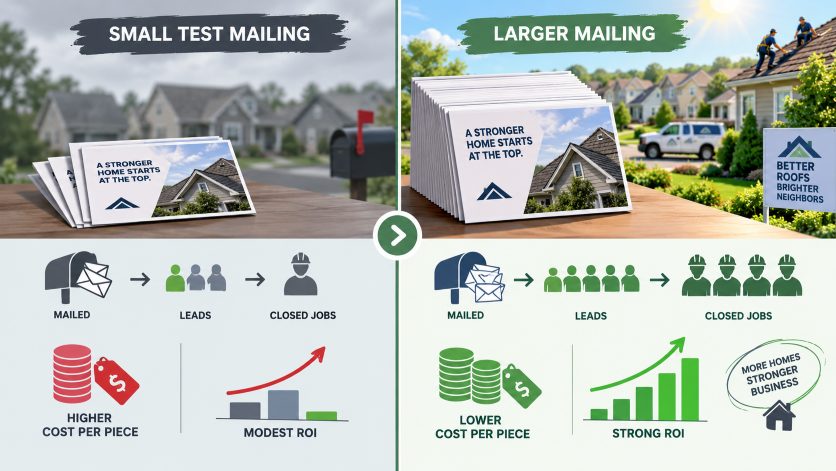 One of the first questions a business owner asks about direct mail is simple: How much does it cost? The more important question is what that cost can produce. Direct mail is not just a printing expense. It is a customer-acquisition system, and the economics can change dramatically depending on how many pieces are mailed, how well the audience is targeted, how many people respond, and how effectively the sales team converts those responses into paying customers.
That is especially true for high-ticket local services such as roofing. A roofing company may only need a small number of new jobs for a mailing campaign to become profitable. At the same time, roofing response rates can be low because most homeowners are not ready to replace a roof on the exact day a postcard arrives. This creates a common trap: a company mails too few pieces, gets only a handful of leads, closes none of them, and concludes that direct mail does not work.
The problem may not be the medium. It may be the sample size and the unit economics. Direct mail has meaningful fixed costs for setup, production, data processing, addressing, postal preparation, and handling. Those costs are spread over every piece in the campaign. As volume increases, the cost per piece can fall sharply. At the same time, a larger campaign produces more opportunities for the law of averages to work. More leads create more chances to close jobs, which can make the results both more profitable and more statistically useful.
The examples below use a hypothetical roofing company mailing a 6 x 11 oversized postcard. The company is considering either a radius mailing around neighborhoods it wants to penetrate or mass mailing postcards to a targeted list of older homes that are more likely to need roof replacement. To keep the math easy to follow, every completed roofing job is assumed to produce $4,000 in profit before marketing cost. The response rates, close rates, mailing costs, and results are scenario assumptions for illustration, not guarantees of future performance.
The First Principle: Direct Mail Has Economies of Scale
The biggest misunderstanding about direct mail pricing is the assumption that a campaign should cost roughly the same amount per piece regardless of quantity. In reality, many of the steps required to produce a mailing have fixed or semi-fixed costs. Files must be prepared. Artwork may need prepress work. A press must be set up. Printed sheets must be cut or trimmed. A mailing list must be processed. Addresses must be applied. Pieces must be sorted according to postal requirements. Postal paperwork must be prepared, and the finished mail must be transported and entered into the postal system.
Whether a company mails 1,000 postcards or 10,000 postcards, many of those steps still have to happen. The setup work does not increase tenfold simply because the quantity increases tenfold. As a result, the fixed portion of the job is divided across more pieces at higher volumes. That is why the cost per postcard can decline so quickly as volume increases.
Using the pricing assumptions in this roofing example, a 1,000-piece campaign costs $1,800, or $1.80 per postcard. At 2,500 pieces, the cost falls to $1.00 per piece. At 5,000 pieces, it falls to $0.90. At 10,000 pieces, it falls again to $0.85. The 10,000-piece campaign is more expensive in total dollars, but each opportunity to reach a homeowner costs less than half as much as it did in the 1,000-piece test.
|
Postcards Mailed |
Total Cost |
Cost Per Piece |
Savings vs. 1,000-Piece Rate |
|
1,000 |
$1,800 |
$1.80 |
— |
|
2,500 |
$2,500 |
$1.00 |
44% lower |
|
5,000 |
$4,500 |
$0.90 |
50% lower |
|
10,000 |
$8,500 |
$0.85 |
53% lower |
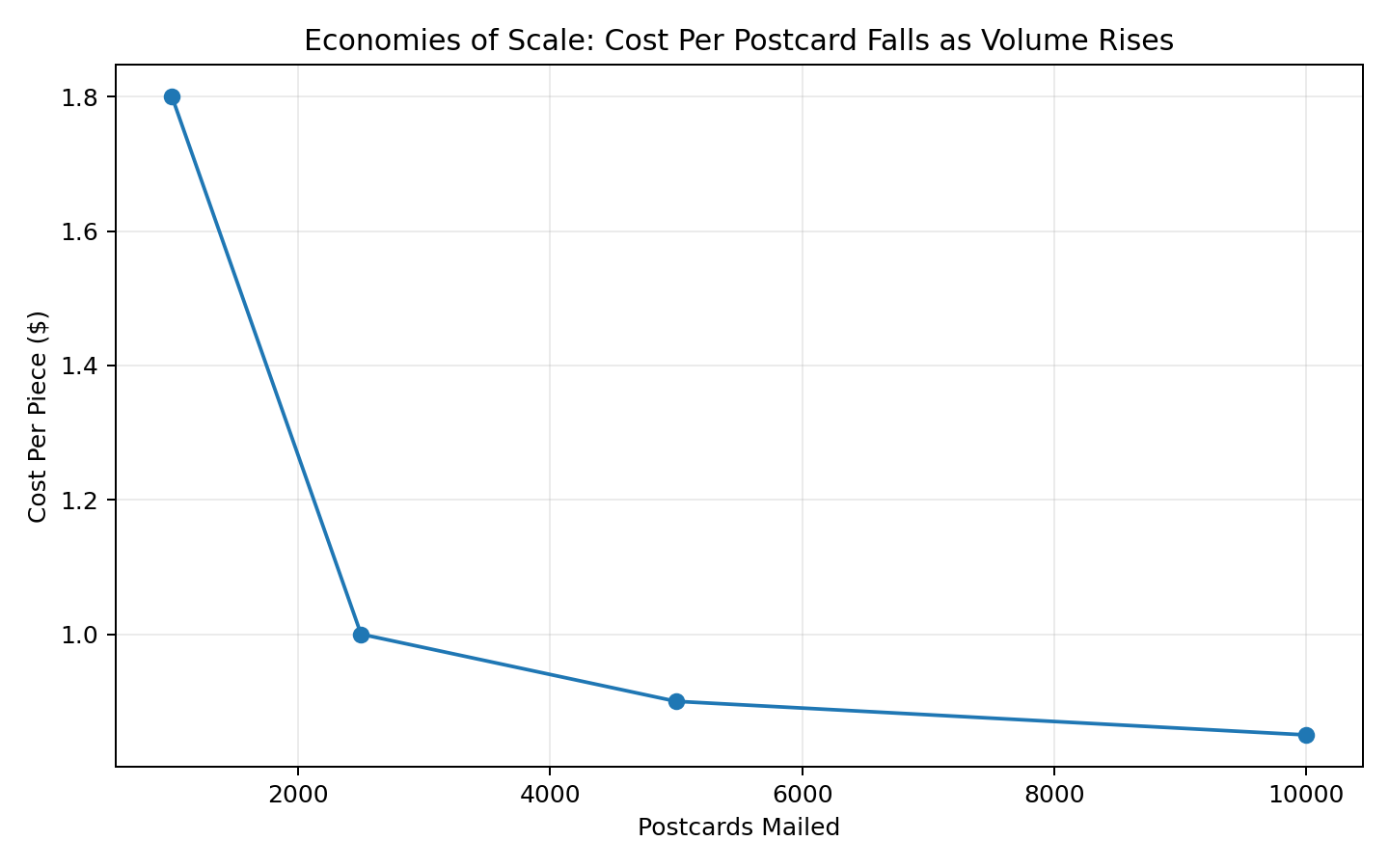
Figure 1. Cost per postcard falls as mailing volume increases.
Why a 1,000-Piece Test Can Produce the Wrong Conclusion
Suppose the roofing company is cautious. It wants to “test” direct mail before committing more money, so it mails the minimum 1,000 postcards at a cost of $1,800. Assume the campaign generates a 0.25% response rate. That produces an expected 2.5 calls for estimates. Of course, no real campaign receives half a phone call; 2.5 is an average expectation. In the real world, the company might receive two calls, three calls, one call, or even none.
Now assume the salesperson closes only 20% of qualified opportunities. Mathematically, 2.5 expected leads multiplied by a 20% close rate equals 0.5 expected jobs. Again, the business cannot sell half a roof. The most likely real-world outcomes are discrete: either no roof is sold, one roof is sold, or occasionally more. If no job is sold, the campaign produces $0 of job profit and the company loses the $1,800 marketing investment.
This is where small tests become dangerous. The owner may say, “We spent $1,800 and got nothing. Direct mail is too expensive.” But what has actually been proven? Very little. With such a small number of expected leads, the final result is highly sensitive to randomness and to the performance of a single salesperson. One missed call, one unreturned voicemail, one homeowner who delays the project, or one weak sales appointment can turn the entire campaign from profitable to apparently unsuccessful.
There is also an important measurement distinction. Some marketers casually describe ROI as “return divided by investment.” Under that approach, a campaign that returns $0 has a 0x return multiple, or a 0% return relative to the amount spent. Standard ROI, however, is calculated as (profit generated minus marketing cost) divided by marketing cost. Under the standard formula, a campaign that spends $1,800 and generates no profit has an ROI of -100%. In this article, we will use standard ROI and also refer to return multiples when useful.
The same 1,000-piece campaign looks very different if it produces just one roofing job. One job at $4,000 in profit generates $4,000 before marketing cost. Subtract the $1,800 mailing cost and the campaign produces $2,200 of net profit, equal to a standard ROI of approximately 122%. Two jobs would generate $8,000 of job profit, $6,200 after the mailing expense, and an ROI of about 344%. With a tiny sample, the difference between zero, one, and two sales is enormous.
How We Calculate Direct Mail ROI
For the remaining scenarios, the calculation is straightforward. First, multiply the number of postcards by the response rate to estimate leads. Next, multiply leads by the sales close rate to estimate jobs. Then multiply completed jobs by the assumed $4,000 profit per roofing job. Finally, subtract the mailing cost and divide that net gain by the mailing cost.
For example, a 5,000-piece mailing with a 0.5% response rate produces 25 expected leads. At a 40% close rate, those 25 leads produce 10 expected jobs. Ten jobs at $4,000 of profit each generate $40,000 of job profit. After subtracting the $4,500 mailing cost, the net gain is $35,500. Standard ROI is $35,500 divided by $4,500, or approximately 789%.
These calculations use profit per job rather than gross sales revenue. That is important. A contractor should not evaluate marketing by comparing mailing cost with top-line roofing revenue if much of that revenue is consumed by materials, labor, commissions, insurance, overhead, or subcontractor expenses. The most useful input is the amount of contribution profit the company reasonably expects from an average completed job.
- Leads = postcards mailed x response rate
- Jobs = leads x sales close rate
- Job profit generated = jobs x $4,000 average profit per job
- Net gain = job profit generated - mailing cost
- Standard ROI = net gain / mailing cost
Scenario 1: 0.5% Response Rate and 40% Close Rate
Now assume the postcard generates a 0.5% response rate and the sales representative closes 40% of those leads. This is a useful middle-of-the-road scenario for understanding how volume affects the economics. At 1,000 postcards, the company expects five leads and two jobs. The $8,000 of job profit creates a $6,200 net gain after the $1,800 mailing cost, for an ROI of 344%.
At 2,500 postcards, the company expects 12.5 leads and five jobs. Job profit rises to $20,000, while the mailing costs only $2,500. Net gain is $17,500 and ROI jumps to 700%. At 5,000 postcards, the campaign produces 25 expected leads and 10 jobs, resulting in a $35,500 net gain and 789% ROI. At 10,000 postcards, the company expects 50 leads and 20 jobs, generating $80,000 of job profit. After the $8,500 mailing expense, the net gain is $71,500 and ROI reaches approximately 841%.
Notice what is happening. The response rate and close rate never improve. The only variable that changes is mailing volume and the corresponding price per piece. Yet ROI improves substantially because the cost of reaching each homeowner falls as scale increases.
|
Volume |
Leads |
Jobs |
Job Profit |
Mail Cost |
Net Gain |
ROI |
|
1,000 |
5 |
2 |
$8,000 |
$1,800 |
$6,200 |
344% |
|
2,500 |
12.5 |
5 |
$20,000 |
$2,500 |
$17,500 |
700% |
|
5,000 |
25 |
10 |
$40,000 |
$4,500 |
$35,500 |
789% |
|
10,000 |
50 |
20 |
$80,000 |
$8,500 |
$71,500 |
841% |
Scenario 2: 0.5% Response Rate and 60% Close Rate
Next, keep the response rate at 0.5% but improve the sales close rate from 40% to 60%. This illustrates another critical point: direct mail ROI is not controlled by the mail piece alone. The sales process matters enormously. Better speed-to-lead, stronger estimating, more disciplined follow-up, financing options, reputation, reviews, and sales training can dramatically increase the value of exactly the same number of responses.
At 1,000 pieces, five leads at a 60% close rate produce three expected jobs. Those jobs create $12,000 of profit before marketing cost and $10,200 after the mailing expense, equal to a 567% ROI. At 2,500 pieces, 12.5 expected leads produce 7.5 expected jobs, or $30,000 in job profit. After the $2,500 mailing cost, ROI is 1,100%.
At 5,000 postcards, 25 leads at a 60% close rate produce 15 jobs and $60,000 in job profit. Net gain after the mailing is $55,500, producing approximately 1,233% ROI. At 10,000 postcards, 50 leads produce 30 jobs and $120,000 of job profit. Subtract the $8,500 campaign cost and net gain is $111,500, for an ROI of roughly 1,312%.
|
Volume |
Leads |
Jobs |
Job Profit |
Mail Cost |
Net Gain |
ROI |
|
1,000 |
5 |
3 |
$12,000 |
$1,800 |
$10,200 |
567% |
|
2,500 |
12.5 |
7.5 |
$30,000 |
$2,500 |
$27,500 |
1,100% |
|
5,000 |
25 |
15 |
$60,000 |
$4,500 |
$55,500 |
1,233% |
|
10,000 |
50 |
30 |
$120,000 |
$8,500 |
$111,500 |
1,312% |
Scenario 3: 1.0% Response Rate and 40% Close Rate
Now double the postcard response rate to 1.0% while returning the sales close rate to 40%. The effect is dramatic because every additional response creates another opportunity to turn a homeowner into a profitable roofing job.
A 1,000-piece campaign now produces 10 expected leads and four jobs. Four jobs create $16,000 in profit before marketing cost. After the $1,800 mailing investment, net gain is $14,200 and ROI is approximately 789%. At 2,500 pieces, 25 leads create 10 jobs and $40,000 in job profit. Subtract the $2,500 mailing cost and ROI is 1,500%.
At 5,000 pieces, 50 leads and a 40% close rate produce 20 jobs. Job profit reaches $80,000, net gain reaches $75,500, and ROI is approximately 1,678%. At 10,000 pieces, 100 leads produce 40 jobs and $160,000 in job profit. After the $8,500 mailing cost, net gain is $151,500 and ROI reaches about 1,782%.
|
Volume |
Leads |
Jobs |
Job Profit |
Mail Cost |
Net Gain |
ROI |
|
1,000 |
10 |
4 |
$16,000 |
$1,800 |
$14,200 |
789% |
|
2,500 |
25 |
10 |
$40,000 |
$2,500 |
$37,500 |
1,500% |
|
5,000 |
50 |
20 |
$80,000 |
$4,500 |
$75,500 |
1,678% |
|
10,000 |
100 |
40 |
$160,000 |
$8,500 |
$151,500 |
1,782% |
Scenario 4: 1.0% Response Rate and 60% Close Rate
The final scenario combines a 1.0% response rate with a 60% close rate. This is the high-performance case, and it demonstrates the leverage that occurs when good targeting, a compelling offer, strong creative, and an effective sales process work together.
At 1,000 postcards, the company expects 10 leads and six jobs. Those jobs generate $24,000 of profit before marketing cost. After spending $1,800 on the mailing, net gain is $22,200 and standard ROI is approximately 1,233%. At 2,500 postcards, 25 leads produce 15 jobs and $60,000 of job profit. After the $2,500 mailing cost, net gain is $57,500 and ROI is 2,300%.
At 5,000 postcards, 50 leads produce 30 jobs. That equals $120,000 of job profit, $115,500 of net gain after the mailing, and approximately 2,567% ROI. At 10,000 postcards, the campaign generates 100 expected leads and 60 expected jobs. At $4,000 of profit per job, that is $240,000 of job profit. After the $8,500 campaign cost, the net gain is $231,500, resulting in approximately 2,724% ROI.
|
Volume |
Leads |
Jobs |
Job Profit |
Mail Cost |
Net Gain |
ROI |
|
1,000 |
10 |
6 |
$24,000 |
$1,800 |
$22,200 |
1,233% |
|
2,500 |
25 |
15 |
$60,000 |
$2,500 |
$57,500 |
2,300% |
|
5,000 |
50 |
30 |
$120,000 |
$4,500 |
$115,500 |
2,567% |
|
10,000 |
100 |
60 |
$240,000 |
$8,500 |
$231,500 |
2,724% |
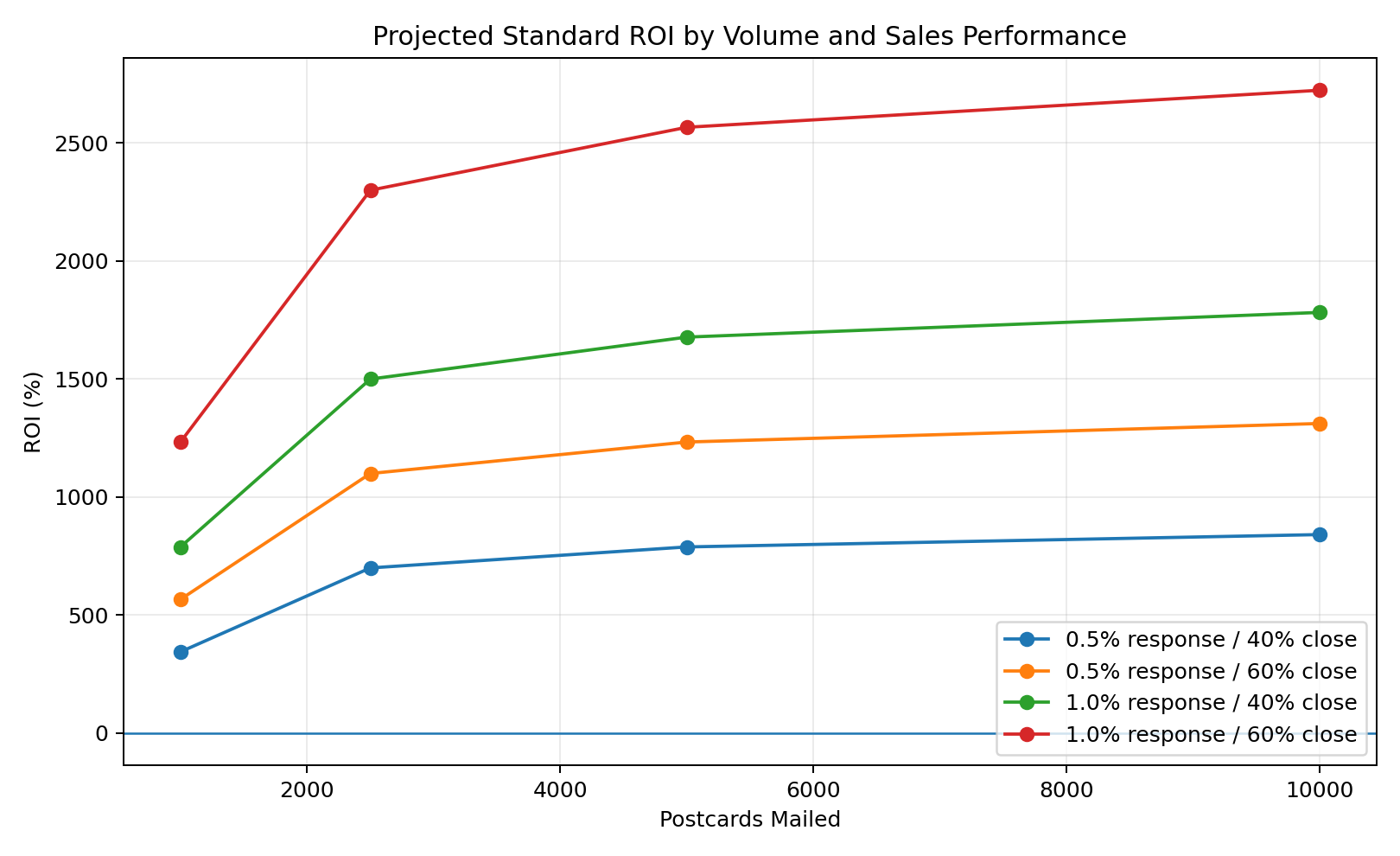
Figure 2. Projected standard ROI under four response-rate and close-rate combinations.
The Cost Per Lead and Cost Per Acquired Job Tell the Same Story
ROI is the headline number, but two other measurements make the economics easier to understand: cost per lead and marketing cost per acquired job. At a 0.5% response rate, the 1,000-piece campaign costs $360 per lead because the company spends $1,800 to generate five responses. The 10,000-piece campaign costs $170 per lead because $8,500 produces 50 responses. The response rate has not changed, but the acquisition economics improve because the mail itself is cheaper per household reached.
The same effect appears in cost per acquired job. At a 0.5% response rate and 40% close rate, the company spends $900 in mailing cost per acquired roofing job at 1,000 pieces. At 10,000 pieces, the mailing cost per acquired job falls to $425. At a 1.0% response rate and 60% close rate, the cost per acquired job falls from $300 at 1,000 pieces to about $142 at 10,000 pieces.
For a company earning $4,000 of profit per completed roof, the difference between spending $900 and $425 to acquire a job is enormous. That difference can be reinvested into additional marketing, sales capacity, trucks, hiring, equipment, or simply retained as profit.
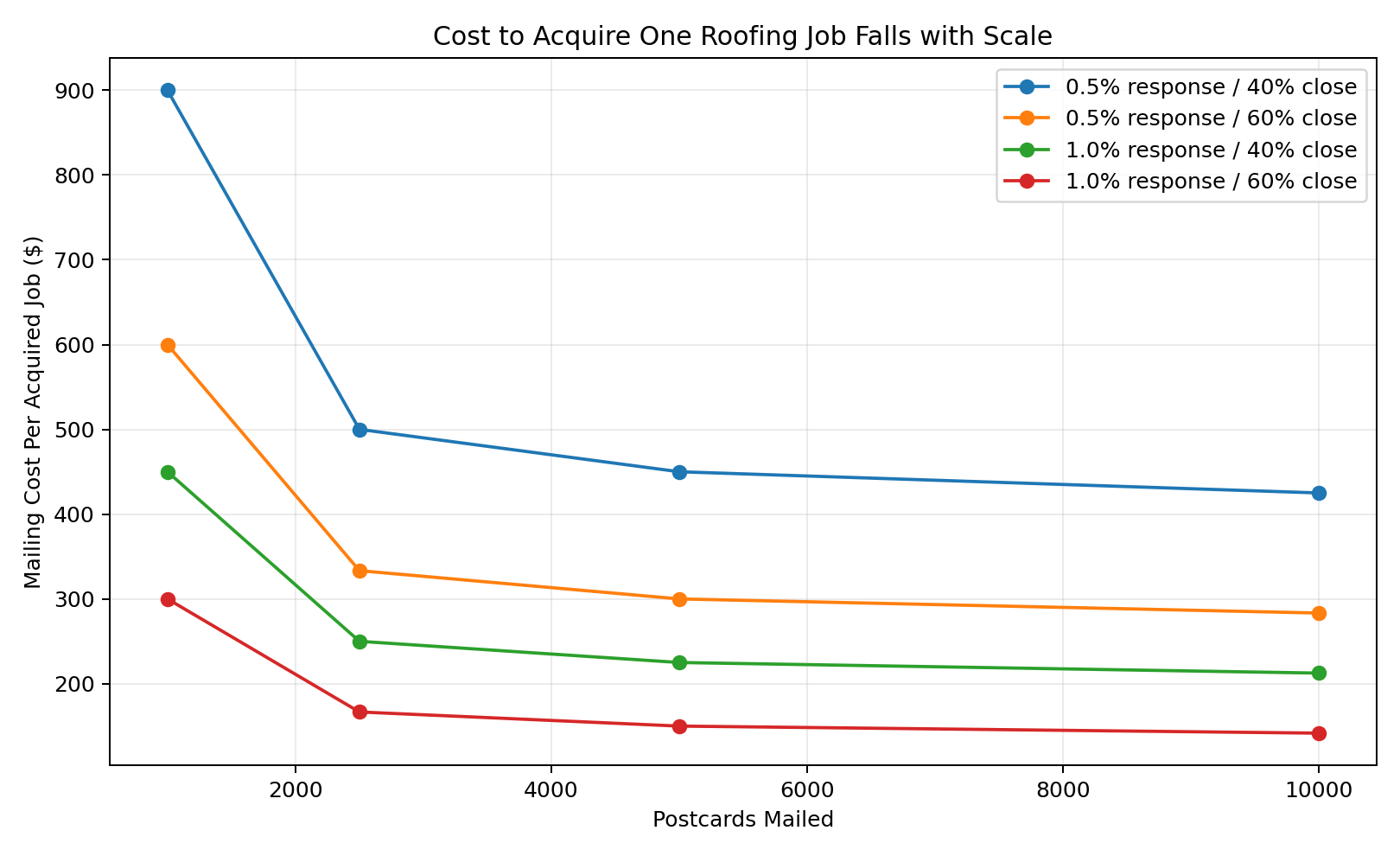
Figure 3. Mailing cost per acquired roofing job declines as volume rises.
Scale Also Lowers the Response Rate Needed to Break Even
Another way to see the advantage of higher volume is to calculate the response rate required just to break even. Break-even occurs when the profit generated by expected closed jobs equals the cost of the mailing. Because cost per piece falls at larger quantities, the company can break even at a lower response rate.
At a 40% close rate and $4,000 profit per roofing job, the 1,000-piece campaign needs a response rate of roughly 0.113% to cover the $1,800 mailing cost. At 2,500 pieces, the break-even response rate falls to about 0.063%. At 5,000 pieces it is about 0.056%, and at 10,000 pieces it is approximately 0.053%.
With a 60% close rate, the threshold falls even further: approximately 0.075% at 1,000 pieces and about 0.035% at 10,000 pieces. In other words, higher volume and better sales execution provide two different forms of protection. Higher volume lowers the marketing cost per opportunity, while a stronger close rate extracts more revenue and profit from each lead that the campaign generates.
|
Volume |
Break-Even Response at 40% Close |
Break-Even Response at 60% Close |
|
1,000 |
0.113% |
0.075% |
|
2,500 |
0.063% |
0.042% |
|
5,000 |
0.056% |
0.038% |
|
10,000 |
0.053% |
0.035% |
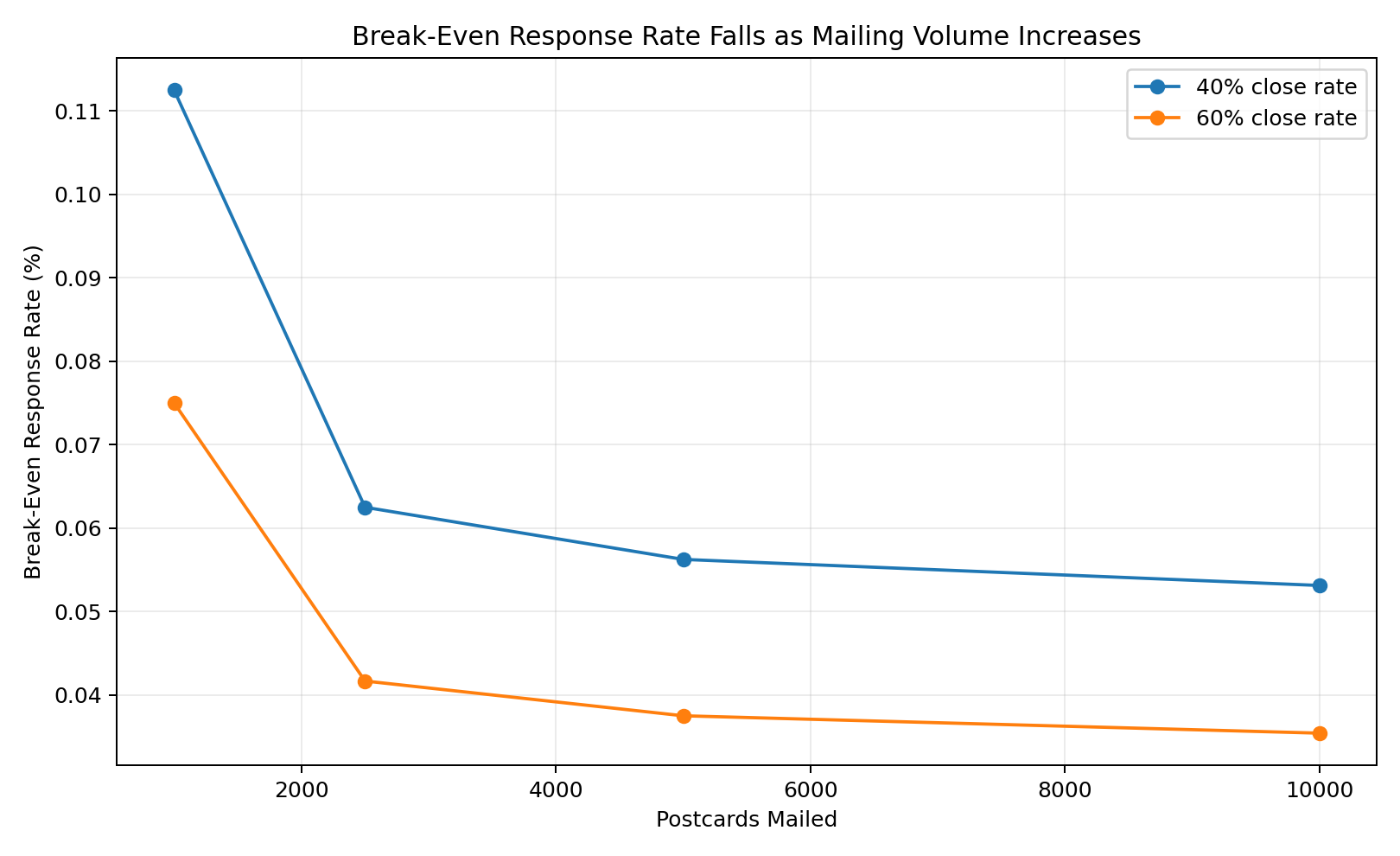
Figure 4. The response rate required to break even falls as volume increases.
A Bigger Mailing Is Not Automatically a Better Mailing
Economies of scale are powerful, but volume should not be confused with indiscriminate saturation. Mailing 10,000 random homes is not necessarily better than mailing 5,000 carefully selected prospects. The objective is to combine enough volume to achieve favorable production economics with enough targeting to maintain relevance.
For a roofing company, geography and property characteristics can be especially important. A radius mailing can make sense around a recently completed job because nearby homeowners can see the contractor's work, recognize the company name, or respond to a neighborhood-specific message. A targeted neighborhood campaign can also focus on subdivisions built during periods when many roofs are approaching a similar replacement age. Other useful filters may include owner occupancy, home value, storm exposure, property type, or other lawful and appropriate data points that correlate with the service being offered.
The best campaign is therefore not simply the largest campaign the budget can afford. It is the largest well-targeted campaign the company can service properly. If the sales team cannot answer calls quickly, schedule estimates, follow up, and complete the work, additional leads can be wasted. Marketing volume and operational capacity should grow together.
Why Response Rate Alone Can Be a Misleading Metric
Marketers often focus on response rate because it is easy to measure, but response rate does not pay the bills. Profit does. A campaign with a lower response rate can outperform a campaign with a higher response rate if the first campaign reaches better prospects, produces larger jobs, or generates leads that close at a higher rate.
Imagine one postcard gets a 1% response rate because it uses a broad discount that attracts price shoppers. Another gets only a 0.5% response rate but reaches homeowners with older roofs and positions the contractor as a trusted premium provider. If the second group closes at a higher rate and produces more profitable jobs, the lower-response campaign may create far more value.
That is why a roofing company should track the entire funnel: pieces mailed, responses, estimate appointments, estimates completed, jobs sold, average job value, profit per job, and final marketing ROI. Tracking only calls can cause the company to optimize for the wrong outcome.
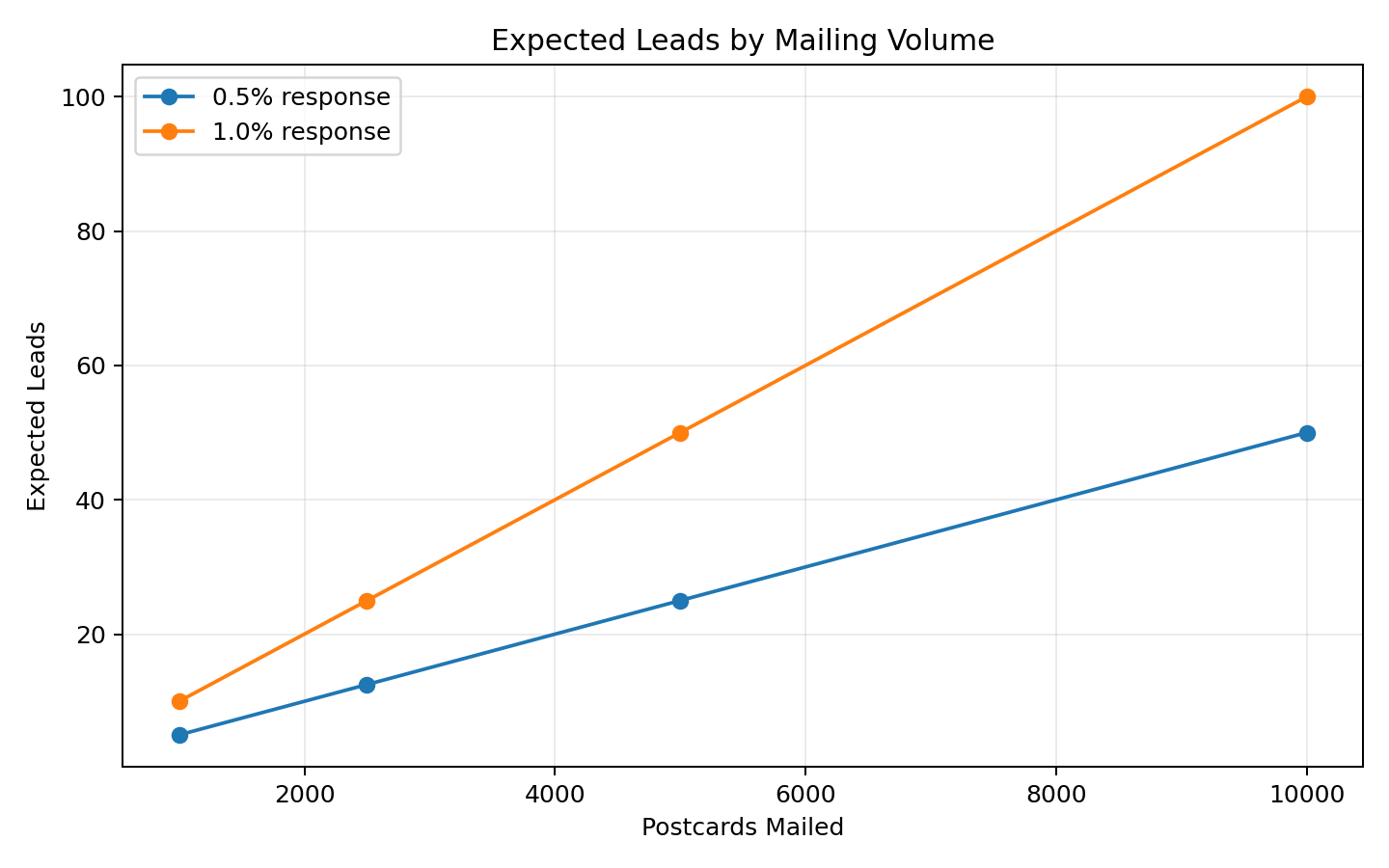
Figure 5. Expected leads increase predictably with volume when the response rate is held constant.
How to Improve Direct Mail ROI Without Simply Mailing More
Increasing volume can improve unit economics, but it is only one lever. The highest-performing direct mail programs usually improve several parts of the funnel at the same time. For a roofing campaign, that means thinking about the list, the postcard, the offer, the timing, and the sales process as one system.
First, improve targeting. A roofing company should prioritize homes and neighborhoods where the probability of need is higher. Second, make the postcard immediately understandable. Homeowners should know who the company is, what service it provides, why the offer matters, and what action to take. Third, make the call to action easy. A clear phone number, QR code, URL, or estimate request can reduce friction.
Fourth, answer and follow up quickly. A lead that costs $170 or $360 to generate is too valuable to lose because a voicemail was not returned. Fifth, track results by campaign or list segment. Use dedicated phone numbers, landing pages, coupon codes, CRM source fields, or other attribution methods so the company knows which neighborhoods and offers are producing jobs.
Finally, consider repetition. Roofing is often a timing-driven purchase. A homeowner may see the first postcard before the need is urgent, notice the second after a storm or leak, and respond to the third when replacement becomes unavoidable. A single drop can measure immediate response, but a well-planned sequence can build recognition and capture prospects as they move into the market.
- Target neighborhoods with a higher probability of roof-replacement need.
- Use a strong headline and clear 6 x 11 postcard design that can be understood in seconds.
- Include a specific and easy-to-use call to action.
- Use dedicated tracking so calls, estimates, jobs, and profit can be tied to the mailing.
- Improve speed-to-lead and sales follow-up before increasing volume.
- Test meaningful variables such as offer, audience, and creative rather than judging the entire channel from one tiny drop.
- Use repeat mailings when the buying cycle and customer economics support them.
- Consider testing letter format mailings against the postcard format. Test and learn is key to success in direct mail marketing.
What Is the Right Direct Mail Test Size?
There is no universal quantity that is correct for every business, but the roofing example shows why a test must be large enough to generate a useful number of opportunities. If a company expects only two or three responses, the outcome may tell it more about randomness than about the quality of the campaign. A better test is one that creates enough expected leads and enough potential sales to evaluate the list, offer, creative, and sales process with some confidence.
That does not mean a company should blindly spend $8,500 instead of $1,800. It means the test should be designed backward from the economics. Estimate a conservative response rate. Estimate a realistic close rate. Determine how many leads are needed to produce enough expected sales to evaluate the program. Then compare that required volume with the company's budget and capacity.
For example, at a 0.5% response rate, 1,000 postcards generate only five expected leads. At 10,000 postcards, the same response rate generates 50 expected leads. Fifty leads allow the company to evaluate sales performance, lead quality, geographic differences, and campaign economics far more intelligently than five leads do.
The Real Question Is Not 'How Much Does Direct Mail Cost?'
The better question is: What does it cost to acquire a profitable customer? A 10,000-piece mailing that costs $8,500 can be a far better investment than a 1,000-piece mailing that costs $1,800 if the larger campaign cuts the cost per lead, reduces the cost per acquired job, and creates enough sales volume to generate a strong net return.
In the roofing scenarios above, the price per postcard falls from $1.80 at 1,000 pieces to $0.85 at 10,000 pieces. At a 0.5% response rate and 40% close rate, projected ROI rises from 344% to 841%. At a 1% response rate and 60% close rate, projected ROI rises from 1,233% to 2,724%. Those figures are not promises; they are illustrations of what happens mathematically when fixed campaign costs are spread across more pieces and the economics of each acquired customer remain attractive.
The lesson is simple. Direct mail should be evaluated as a complete acquisition system, not as a printing bill. Volume matters. Targeting matters. Response rate matters. Sales execution matters. Profit per job matters. When those pieces are measured together, a business can determine not only whether direct mail works, but how to scale it intelligently.
For a roofing company with strong job margins and a capable sales team, the biggest risk may not be that direct mail is too expensive. The bigger risk may be running such a small test that the company never gives the channel enough scale to reveal its true economics.
Important Note About the Example
All campaign prices, response rates, close rates, job profit figures, and ROI results in this article are illustrative scenario assumptions supplied for this example. Actual results vary by market, list quality, creative, offer, timing, competition, sales execution, postal costs, production specifications, and other factors. Businesses should calculate ROI using their own contribution profit and actual tracked campaign results.
FAQ About Direct Mail Campaigns
1. Does direct mail pricing usually include postage?
Not always. Some direct mail companies advertise a printing price and then charge separately for postage, mailing lists, addressing, data processing, sorting, setup, and other mailing services. This can make it difficult to compare quotes accurately.
When requesting a direct mail quote, ask for the total cost to print, prepare, and mail the campaign, including postage.
Mail King USA simplifies this by providing turnkey pricing designed to cover the major components of the mailing rather than adding separate fees for every small step. This makes it easier for businesses to understand their actual campaign cost before placing an order.
2. What should be included in a direct mail quote?
A complete direct mail quote may include printing, addressing, mailing-list services, postal sorting, postage, data processing, mail preparation, and delivery to USPS. Design services may also be included or quoted separately depending on the project.
The most important thing is to compare complete campaign costs rather than printing prices alone. A quote of 25 cents per printed postcard is not necessarily less expensive than a 60-cent turnkey quote if postage and mailing services still have to be added.
Before approving a job, make sure you know exactly what is - and is not - included.
3. How long does it take to print and mail a direct mail campaign?
Production time varies by provider, quantity, format, and time of year. For many standard postcard campaigns, businesses should allow several business days for printing and mailing preparation in addition to USPS delivery time.
Speed is one area where Mail King USA stands out. Most standard jobs are typically printed, processed, and mailed within about 2 to 4 business days after final approval, making it a good option for businesses with time-sensitive campaigns.
Remember that production time and postal delivery time are different. Once the mailing enters the USPS system, delivery timing depends on the postage class, destination, and current postal conditions.
4. Is it better to use one company for design, printing, mailing lists, and mailing?
For many businesses, yes.
Using one full-service direct mail company eliminates the need to coordinate separately with a designer, printer, list company, and mailing house. It also reduces the number of times files and customer data have to be transferred between vendors.
Mail King USA can handle the process in one place - from design and mailing-list selection through printing, postal preparation, and mailing. Consolidating those services can simplify the project and may also reduce costs associated with multiple vendors, markups, shipping, and duplicated setup work.
5. Do I need to design my own direct mail postcard?
No. You can provide finished artwork if you already have it, or work with a designer who understands direct mail.
A good postcard design needs to do more than look attractive. It should communicate the offer quickly, clearly identify the business, include a strong call to action, and leave the appropriate space for mailing information.
When possible, work with someone familiar with postal requirements so your design does not have to be significantly modified after it reaches the printer.
6. Do I need to provide my own mailing list?
No. You can use your own customer or prospect database, purchase a targeted mailing list, or use geographic options such as saturation or radius mailing.
If you already have a list, it should usually be cleaned before mailing to remove duplicates and identify address problems. If you need a new audience, mailing data can often be filtered by geography and other available consumer, business, household, or property characteristics.
Mail King USA can provide targeted mailing lists and also processes customer-provided lists as part of its mailing services.
For a deeper explanation of list strategy, King's Corner has a useful guide on How to Create a Mailing List for Your Next Direct Mail Campaign. Read the mailing-list guide.
7. Can I choose which neighborhoods or customers receive my direct mail?
Yes. Direct mail can be targeted very broadly or very precisely depending on the campaign.
- ZIP Code
- Neighborhood
- Postal carrier route
- Geographic radius
- Consumer characteristics
- Business type
- Property characteristics
- Other available mailing-list criteria
For example, a roofing company may want to concentrate its mailing around neighborhoods with older homes rather than sending postcards equally across an entire city.
The objective is not simply to reach the largest number of people. It is to reach enough of the right people to generate profitable results.
8. Should I use EDDM or a targeted mailing list?
It depends on how broad your potential customer base is.
Every Door Direct Mail (EDDM) is useful when almost every household in a selected area could be a potential customer. Restaurants, retail stores, lawn-care companies, and some home-service businesses may fit this model.
A targeted mailing list is often better when you want to narrow the audience using specific criteria.
For example, if you only want to reach homeowners in certain neighborhoods or businesses within a particular industry, paying to mail every address in a carrier route may create unnecessary waste.
The best choice is usually the one that produces the lowest cost to reach a qualified prospect, not necessarily the lowest postage rate.
9. What is the best postcard size for direct mail marketing?
There is no single best size for every campaign. The right choice depends on the amount of information you need to communicate, your budget, and how much visibility you want in the mailbox.
- 4 x 6
- 5.5 x 8.5
- 6 x 9
- 6 x 11
For many prospecting campaigns, 6 x 11 is an especially attractive size because it provides a large amount of marketing space while still fitting within letter-class size limits when properly designed. Mail King USA frequently recommends it for that reason.
King's Corner has a complete comparison in What's the Best Postcard Size for Direct Mail Marketing? Compare direct mail postcard sizes.
10. How can I reduce direct mail costs without sacrificing results?
Start by reducing waste rather than simply choosing the cheapest paper or smallest postcard.
- Cleaning your mailing list
- Removing duplicate records
- Improving audience targeting
- Mailing sufficient volume to obtain better unit pricing
- Choosing a postal-friendly format
- Using the appropriate postage class
- Avoiding unnecessary production features
- Consolidating printing and mailing services
It is also important to consider cost per lead and cost per customer, not just cost per piece.
A slightly more expensive postcard that reaches better prospects and generates more customers may ultimately be far less expensive than a cheaper mailing that produces poor results.
For more ideas, see King's Corner's 10 Ways to Minimize Direct Mail Marketing Costs. See 10 ways to reduce direct mail costs.
11. Should I put a QR code on my direct mail postcard?
In many cases, yes. A QR code gives recipients an easy way to move from a physical mail piece to a digital destination.
- A landing page
- Online estimate request
- Appointment scheduler
- Coupon
- Product page
- Video
- Event registration page
- Store location
- Online ordering page
The key is to pair the QR code with a clear call to action. 'Scan for a Free Estimate' is much more effective than simply placing an unexplained QR code on the postcard.
Mail King's King's Corner has a dedicated guide to Using QR Codes With Direct Mail Services with additional examples. Read the QR code direct mail guide.
12. How can I track whether my direct mail campaign is working?
Direct mail can be tracked using several methods, including:
- Dedicated phone numbers
- QR codes
- Unique landing pages
- Promotional codes
- Custom URLs
- CRM campaign-source fields
- Asking new customers how they heard about you
It is often smart to use more than one method.
For example, a homeowner may receive your postcard, remember your company name, and then search for your business on Google rather than scanning the QR code. If you only count QR scans, you might underestimate the campaign's results.
The most useful tracking ultimately connects the original mailing to leads, sales, and profit, not simply website visits.
13. What happens if my mailing list contains duplicate or outdated addresses?
Bad mailing data costs money because you are paying to print and mail pieces that may never reach a useful prospect.
Before mailing, lists can be processed to identify issues such as:
- Duplicate records
- Improperly formatted addresses
- Address changes
- Potentially undeliverable addresses
- Unwanted records
Mail King USA includes mailing-list processing with its postcard mailing services, helping clients identify and reduce avoidable waste before the campaign is mailed.
Even a small percentage of bad records can become significant when mailing tens of thousands of pieces.
14. How far in advance should I plan a direct mail campaign?
For a normal marketing campaign, it is wise to allow enough time for artwork approval, list preparation, printing, mailing preparation, and USPS delivery.
Businesses with a specific deadline - such as an event, grand opening, election, sale, or seasonal promotion - should work backward from the desired in-home date, not simply the mailing date.
Because Mail King USA typically prints and mails standard jobs within roughly 2 to 4 business days, businesses can often launch campaigns relatively quickly, but postal transit time still needs to be factored into the schedule.
For highly time-sensitive mailings, discuss the deadline with your mail provider before finalizing the format or postage class.
15. What should I look for when choosing a direct mail company?
Look beyond the advertised price per postcard.
A good direct mail provider should be able to clearly explain:
- What is included in the quote
- Mailing-list options
- Postal requirements
- Printing specifications
- Production turnaround
- Data processing
- Postage options
- Tracking
- Who is responsible if something needs to be corrected
For many businesses, there is also real value in having one company responsible for the entire mailing rather than coordinating several separate vendors.
Mail King USA's model is built around that approach - providing list assistance, design, printing, mailing preparation, and postal services in one place while keeping pricing straightforward.
The goal should be to find a partner that makes direct mail easier to execute and easier to measure, not simply the vendor with the lowest advertised printing price.