How to Use AI to Create Better Small Business Offers
Artificial intelligence can write headlines, design advertisements, analyze data, generate images, and brainstorm marketing campaigns in seconds. But one of the most useful applications of AI for a small business may be much simpler:
Use AI to help create a better offer.
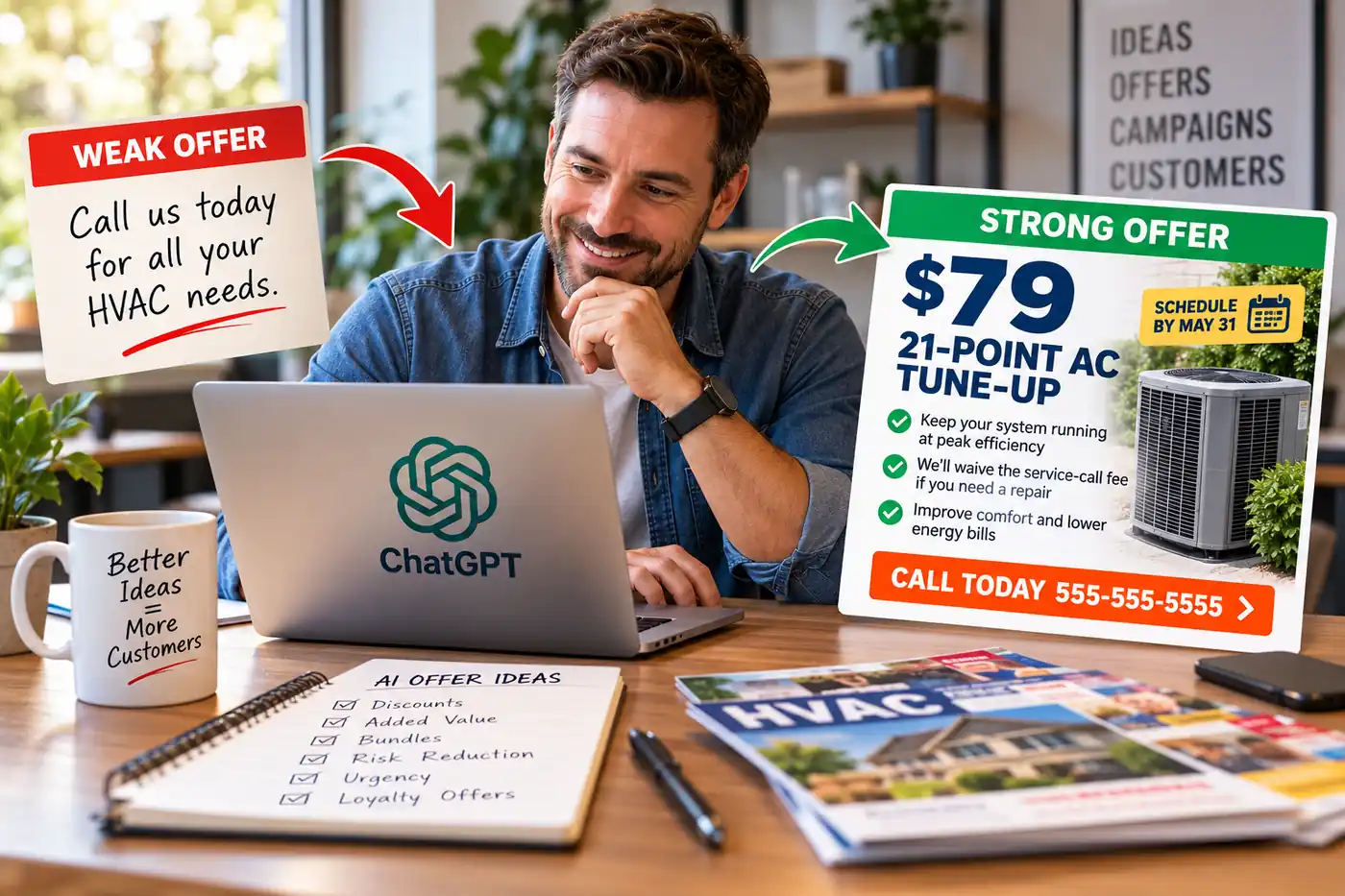 That may not sound as exciting as having AI design an entire advertising campaign, but the offer is often the part of the marketing message that determines whether someone takes action.
Consider the difference between these two advertisements:
“Call us today for your HVAC needs.”
“Get a 21-Point AC Tune-Up for $79 before May 31—and we’ll waive the service-call fee if you need a repair.”
The second version gives the customer something concrete to evaluate. There is a defined service, a price, a deadline, and an additional benefit.
The challenge for many small-business owners is coming up with offers like this consistently without simply discounting everything they sell.
That is where AI can be surprisingly helpful.
Tools such as ChatGPT, Gemini, Claude, and other generative AI platforms can function as brainstorming partners. You can give them information about your business, customers, profit margins, seasonality, services, competitors, and marketing objectives and ask them to generate dozens of potential offers in minutes.
The important part is understanding what AI is good at—and what decisions still belong to the business owner.
AI can generate ideas.
You still have to decide whether the offer makes financial sense, whether you can fulfill it, and whether every claim in the advertisement is true.
That distinction is important.
Why the Offer Matters So Much
A lot of advertising focuses on the company:
“We've been serving the community since 1997.”
“We provide outstanding service.”
“We're family owned.”
“We use the highest-quality products.”
Those may all be valuable credibility points. But they do not necessarily answer the question running through the customer's mind:
Why should I respond now?
A good marketing offer gives the customer a reason.
It might involve a discount, but it doesn't have to.
An offer could be a free consultation, complimentary inspection, bonus service, bundled package, free upgrade, extended warranty, priority appointment, trial period, guaranteed response time, educational report, special financing arrangement, introductory service, or another form of added value.
The U.S. Small Business Administration recommends that businesses clearly define their target market, competitive advantage, pricing strategy, promotions, and the steps a customer takes once they decide to buy. Those same ingredients are extremely useful when asking AI to develop an offer. SBA marketing and sales guidance
The better AI understands the customer and the economics of the business, the better its suggestions can become.
The Biggest Mistake: Asking AI for an Offer Without Giving It Context
Imagine telling ChatGPT:
Give me 10 marketing offers for a roofing company.
You will probably get some usable ideas.
But you are also likely to get fairly generic suggestions: percentage discounts, free estimates, referral bonuses, seasonal promotions, and similar concepts.
Now imagine giving AI this information instead:
We are a residential roofing contractor. Our average roof replacement is $14,000 and our gross margin is approximately 35%. Roof repairs average $850. Our ideal customer owns a home worth at least $350,000 and lives within 30 miles of our office. We don't want to compete primarily on price. Our strongest advantages are fast scheduling, a 10-year workmanship warranty, financing, and excellent reviews. Spring is our busiest lead-generation period. Generate 15 offers for a postcard campaign. Include some price-based offers but focus primarily on added value, reduced risk, convenience, and urgency. For each offer, explain why a homeowner might respond and identify any potential downside to the offer.
That is a completely different assignment.
AI now understands your customer, economics, competitive position, and limitations.
The quality of the information going into the AI greatly affects the usefulness of the ideas coming out.
Give AI the Same Information You Would Give a Good Marketing Consultant
Before asking AI to create an offer, give it enough information to understand the business.
The most useful information generally includes who you want to reach, what you sell, your typical transaction size, your approximate margins, your strongest competitive advantages, common customer objections, seasonal factors, what competitors commonly offer, what you are unwilling to discount, and exactly what action you want the prospect to take.
You don't necessarily have to know every number.
Even statements such as “we have high margins on maintenance agreements but low margins on equipment,” or “our biggest problem is getting first-time customers through the door,” give AI important context.
This also reduces one of the biggest problems with generative AI: it will gladly make assumptions when information is missing.
Marketing strategy should not be built around guesses that an AI system quietly invented.
Don't Ask AI for One Offer. Ask for Different Types of Offers.
One of AI's biggest strengths is speed.
Instead of asking for “the best offer,” ask it to explore several different approaches.
For example, suppose you own a landscaping company.
A simple discount offer might be:
$100 Off Your First Landscaping Project of $1,000 or More
That might work.
But AI could also explore an added-value offer:
Book Your Spring Cleanup and Receive a Complimentary Lawn & Landscape Health Assessment
Or a bundle:
Spring Reset Package: Cleanup + Mulch Installation + Shrub Pruning at One Package Price
Or risk reduction:
Not Sure What Your Yard Needs? Schedule a Free 20-Minute Landscape Planning Visit
Or scarcity:
We’re Opening 25 New Weekly Lawn-Care Routes in Your Neighborhood for Spring
Or a convenience-based offer:
Get Your Entire Spring Cleanup Done Before Memorial Day—One Call, One Crew, One Appointment
Those offers appeal to different motivations.
The point is not that AI automatically knows which one will work best.
The value is that a business owner can explore 20 ideas in the amount of time it might previously have taken to develop two.
AI Can Help You Find Value Without Automatically Cutting Your Price
This is especially important for businesses with good reputations or premium services.
 The easiest marketing idea in the world is:
20% OFF!
But constant discounting can train customers to wait for promotions and can damage margins.
Instead, ask AI:
Generate 20 offers that increase perceived value without reducing my normal selling price.
That one instruction can lead to much better ideas.
- A dentist might offer complimentary whitening with a qualifying new-patient treatment.
- An HVAC company could include a free indoor-air-quality assessment with a tune-up.
- An auto repair facility might include a complimentary multi-point inspection.
- A B2B consultant might offer a 30-minute strategy session or an industry benchmark report.
- A restaurant might bundle an appetizer or dessert rather than discounting the entire check.
- A home-remodeling company might offer a complimentary design consultation.
The actual economics matter, of course. Something the customer perceives as having significant value may cost the company relatively little to provide.
AI can help identify those opportunities because it can rapidly brainstorm combinations that a business owner may not have considered.
Use AI to Match the Offer to the Customer
One reason generic promotions underperform is that not every customer values the same thing.
Imagine an HVAC company marketing to three groups.
A homeowner whose air conditioner is 18 years old has a different problem than someone who installed a new system two years ago.
A new homeowner has different needs from someone who has lived in the same house for 25 years.
A customer who has previously purchased from the company is different from a completely cold prospect.
Instead of asking AI for one universal promotion, describe each group.
You might ask:
I want three different offers for these audiences: homeowners with older HVAC systems, homeowners who recently moved, and previous customers who haven't used us in three years. The goal is to generate service appointments. Create an offer specifically around the likely concerns of each audience.
This is where AI can become particularly useful when paired with targeted marketing.
The message, mailing list, and offer begin working together instead of functioning as separate decisions.
For businesses using direct mail, this can be especially powerful because lists can often be segmented geographically or demographically, allowing different creative and offers to be mailed to different groups.
Use AI to Strengthen an Offer You Already Have
You don't always need AI to invent the promotion.
Sometimes the better use is to improve an existing one.
Suppose your offer is:
$50 Off Any Plumbing Repair
Ask AI to critique it.
Evaluate this direct-mail offer from the perspective of a homeowner: “$50 Off Any Plumbing Repair.” What questions or objections might reduce response? Give me 10 ways to make the offer feel more valuable, credible, specific, or urgent without becoming misleading.
AI may suggest clarifying the minimum purchase, adding an expiration date, explaining whether the discount applies to the service call, combining the discount with a secondary benefit, or emphasizing emergency availability.
You might ultimately end up with:
Save $50 on Any Plumbing Repair of $250 or More—Plus Get a Complimentary Whole-Home Plumbing Inspection. Schedule by June 30.
The underlying economics haven't necessarily changed dramatically.
The presentation has.
Ask AI to Think Like the Customer, Not the Business Owner
This is one of my favorite ways to use AI for marketing.
 After developing an offer, change perspectives.
Ask:
You are a homeowner receiving this postcard in the mail. You have never heard of our company. Give me the five reasons you might ignore this offer, five questions you’d have before responding, and five changes that could make the offer more compelling.
This can expose weaknesses surprisingly quickly.
- Perhaps the offer doesn't explain what's included.
- Maybe the discount sounds suspiciously large.
- Maybe there is no reason to trust the company.
- Maybe the customer assumes there will be a high-pressure sales pitch.
- Maybe the deadline seems artificial.
- Maybe the next step requires too much work.
A good marketer eventually develops the ability to see an advertisement through the customer's eyes.
AI can help simulate that exercise almost instantly.
Use AI to Reduce Friction
Sometimes a promotion is attractive but difficult to redeem.
Consider:
Call our office for details regarding our seasonal maintenance promotion.
The customer has to call without knowing what the promotion even is.
Compare that with:
Schedule your $79 AC Tune-Up by May 31. Scan the QR code to choose your appointment or call 555-555-5555.
The second offer explains what happens next.
You can ask AI specifically to identify friction:
Review this offer and call to action. Identify anything that could make the customer hesitate, become confused, or postpone responding. Rewrite it so the next step is obvious and easy.
This applies far beyond direct mail. The same process can improve website offers, email campaigns, paid advertisements, social posts, landing pages, and sales scripts.
Use AI to Create More Credible Urgency
Urgency works because it gives people a reason not to postpone a decision indefinitely.
But urgency should be real.
“ONLY THREE LEFT!” is not good marketing if you actually have unlimited availability.
Neither is inventing an arbitrary deadline and then extending it every week.
Instead, tie urgency to something legitimate: seasonal capacity, scheduling availability, an actual promotional period, inventory, an event, a rate change, or another real business constraint.
AI can help brainstorm legitimate reasons to act now.
For example:
Generate 15 ethical urgency ideas for a residential painting company launching a spring direct-mail campaign. Do not use fake scarcity. Base the ideas on scheduling capacity, seasonality, weather, project planning, and legitimate promotional deadlines.
That final instruction matters.
AI will optimize toward what you ask it to do. Your job is to set the boundaries.
Don't Let AI Invent Facts, Savings, Reviews, or Guarantees
This deserves special emphasis.
AI-generated marketing copy can sound extremely convincing even when the underlying claim has never been verified.
Do not allow AI to invent things such as “normally $299,” “save 40%,” “rated #1 in Louisville,” “9 out of 10 customers prefer us,” “only five appointments remain,” or “guaranteed to lower your energy bill” unless those statements are actually true and supportable.
The Federal Trade Commission's advertising guidance states that advertising must be truthful and non-deceptive and that advertisers must have evidence supporting objective claims. The FTC also emphasizes that important conditions and disclosures need to be sufficiently clear and conspicuous. FTC Advertising FAQs: A Guide for Small Business
That principle applies whether the advertisement was written by an employee, an agency, or an AI system.
AI is the writing tool. The business is still responsible for the advertisement.
This is particularly important when using words such as “free,” making savings claims, advertising guarantees, comparing yourself with competitors, or placing conditions on a promotion.
Make Sure the Offer Works Financially Before You Advertise It
An AI system can suggest a brilliant-sounding promotion that loses money every time someone redeems it.
That isn't a successful offer.
Before launching a promotion, calculate what happens if it works extremely well.
Suppose a restaurant offers $20 off a $50 purchase.
If 500 people redeem it, can the restaurant handle the volume? What is the food cost? Does the average customer spend more than the minimum? How many become repeat customers?
Similarly, suppose an HVAC contractor offers a heavily discounted tune-up.
Perhaps the tune-up itself produces little or no profit, but if the company knows from its own historical data that a certain percentage of tune-up customers become profitable repair or replacement customers, the economics may still make sense.
That is a business decision.
You can give AI your assumptions and ask it to model scenarios, but verify the calculations yourself and use actual company data whenever possible.
The SBA's marketing guidance encourages businesses to connect promotions and pricing strategy with broader marketing and sales goals rather than treating promotions as isolated tactics.
For a deeper look at campaign economics, Mail King USA's direct-mail cost and ROI guide explains why cost per lead and cost per acquired customer are usually more meaningful than simply looking at cost per mailpiece.
Turn One Offer Into Several Testable Versions
Once you have a promising idea, AI makes variation extremely easy.
Instead of changing the entire advertisement, create controlled versions.
For example, one roofing campaign could test:
| Version | Offer |
|---|---|
| A | $500 Off a Complete Roof Replacement |
| B | Free Gutter Upgrade With Qualifying Roof Replacement |
| C | Free Roof Inspection + 10-Year Workmanship Warranty |
| D | Reserve Your Spring Installation by March 31 and Lock In Current Pricing |
These are fundamentally different value propositions.
The winning offer may tell you something important about the customer.
Perhaps customers are motivated primarily by immediate savings. Or maybe risk reduction through a warranty produces a stronger response. Perhaps scheduling certainty matters more than either.
This is where AI should lead to more testing, not more guessing.
Direct Mail Is a Great Place to Test AI-Generated Offers
Direct mail gives small businesses several practical ways to test promotions.
You can divide a mailing list into comparable groups, mail different offers, and assign each version a unique promotional code, phone number, QR code, landing page, or URL.
USPS recommends making mailpieces actionable through clear calls to action, coupons, reply mechanisms, and other response devices. Format should also match the message and offer—for example, postcards work well for promotions that need immediate visibility, while letters provide more room for persuasion and explanation. USPS Customized Direct Mail guidance
This is also why the format of your campaign matters.
If your offer is simple—“$100 Off Your First Service Before December 31”—a postcard may be ideal because the customer sees the offer immediately.
Mail King USA's postcard mailing services can handle the design, printing, mailing list, addressing, postage, and mailing process for this type of campaign.
On the other hand, if you're selling a complex or higher-value service that needs explanation, a personalized letter may give you more room to build a case, answer objections, explain the offer, and establish credibility.
Our direct mail letter services support personalized letter campaigns, including variable data and mail-merge options.
A Simple AI Offer-Creation Workflow for Small Businesses
You don't need sophisticated marketing software to start.
- Begin by giving the AI a short description of your business, customer, service, average transaction, competitive advantages, margins or pricing limitations, current marketing objective, and what you want the customer to do.
- Then ask for 20 offer concepts across several categories—not merely discounts.
- Take the most promising ideas and ask the AI to attack them from the customer's perspective.
- Next, ask it to identify confusing terms, weak value propositions, credibility problems, and unnecessary friction.
- Then have it create several versions of the strongest concept for testing.
- Finally, review every claim yourself, run the economics, verify your fulfillment capacity, and make sure the offer is accurately described.
Only then should it become an advertisement.
This process can compress hours of brainstorming into a relatively short session while leaving the most important decisions with the business owner.
A Reusable AI Prompt for Creating Better Marketing Offers
Here is a starting prompt you can adapt for your own company:
I own a [TYPE OF BUSINESS] serving [TARGET CUSTOMER] in [MARKET/AREA]. Our primary services/products are [SERVICES]. Our average transaction is approximately [AMOUNT], and our most profitable products/services are [DETAILS]. Our strongest competitive advantages are [ADVANTAGES]. Customers commonly hesitate because of [OBJECTIONS]. Our goal with this campaign is [GOAL].Generate 20 marketing offers. Do not rely only on discounts. Include price-based offers, added-value offers, bundles, bonuses, risk-reversal ideas, convenience offers, introductory offers, loyalty offers, and legitimate urgency.For each idea, explain why the target customer might respond, what business risk or cost the offer creates, and any terms that should be clearly disclosed.Do not invent facts, prices, savings percentages, guarantees, inventory limits, customer reviews, or scarcity that I have not provided.After generating the ideas, rank the five strongest based on perceived customer value, simplicity, differentiation, profitability potential, and ease of communicating in an advertisement.
You can then follow with:
Now pretend you are the target customer and have never heard of this company. Critique the five finalists. What makes you skeptical? What is confusing? What would make each offer more credible?
That second prompt is often just as valuable as the first.
AI Can Help With the Rest of the Campaign, Too
Once you've settled on an offer, AI can help translate it into the rest of the advertising campaign.
You can ask it to create headlines, subheadlines, benefit statements, calls to action, landing-page copy, email follow-ups, social-media variations, sales scripts, and even creative concepts.
We previously covered many of these possibilities in King's Corner's guide to using AI in direct mail marketing.
And in a separate real-world experiment, we gave ChatGPT a Mail King USA production template, our website, and a short set of instructions and asked it to design an actual postcard. In just over six minutes, it produced front-and-back artwork and a usable print-ready PDF. You can see the complete experiment in our AI postcard design case study.
The lesson from both experiments is similar.
AI becomes most valuable when you stop asking it abstract questions and start giving it real business problems.
The Best Offer Usually Isn't the Cleverest One
Business owners sometimes assume an offer needs to be extremely creative.
Usually, it needs to be clear.
A customer should quickly understand what they're getting, why it matters, what they need to do, and whether there is a legitimate reason to act now.
AI can help generate dozens of creative concepts.
Your job is to simplify them.
If a prospect needs three paragraphs to understand a coupon, it probably isn't a very good coupon.
If the terms make the promotion feel like a trap, additional creativity will not fix it.
And if the offer sounds almost too good to be true, customers may assume that it is.
Clarity builds confidence.
AI Is a Brainstorming Partner, Not Your Marketing Director
There is a temptation with new AI tools to hand over the entire decision.
“Tell me the best offer.”
“Tell me what price will work.”
“Tell me which one will generate the most leads.”
AI can provide an opinion, but unless the system has your real campaign history, customer behavior, economics, competitive data, and conversion results, it does not actually know which offer will win.
It may give a very persuasive explanation anyway.
That is why the right mindset is to use AI for idea generation, critique, variation, and analysis—and use real-world testing to determine what works.
Think of AI as a marketing brainstorming partner that can generate 50 ideas without getting tired.
The business owner still brings something the AI doesn't have:
actual knowledge of the customer and the business.
Combine the two, and the result can be extremely powerful.
Final Thoughts
Creating stronger offers has always required a mixture of customer understanding, creativity, economics, and testing.
AI doesn't change those fundamentals.
What it changes is how quickly you can explore the possibilities.
A small-business owner who previously came up with three promotions during a one-hour meeting can now potentially explore 30, compare them from multiple customer perspectives, rewrite the strongest candidates, identify possible objections, and create several test variations in the same amount of time.
That is a meaningful advantage.
The businesses that benefit most from AI may not be the ones that simply generate the most content.
They may be the businesses that use AI to think through important marketing decisions more thoroughly and test more good ideas.
Start with your next promotion.
Give AI the details of your business.
Tell it what you are trying to accomplish.
Ask it for ideas you haven't considered.
Then apply your own experience, verify the claims, check the math, and test the best ones in the real world.
You may discover that one of AI's most valuable marketing capabilities isn't creating the advertisement.
It's helping you figure out what the advertisement should offer in the first place.
Frequently Asked Questions About Using AI to Create Marketing Offers
Can AI create marketing offers for a small business?
Yes. Generative AI tools can brainstorm discount offers, bundles, bonuses, free consultations, added-value promotions, loyalty offers, seasonal promotions, risk-reversal ideas, and other concepts. The business owner should still review profitability, accuracy, fulfillment requirements, and advertising compliance before using an offer publicly.
What information should I give AI before asking for offer ideas?
Give it information about your business, target customer, products or services, average sale, margins or pricing limitations, competitive advantages, common customer objections, seasonality, campaign objective, and the action you want prospects to take. The more relevant context you provide, the less the AI has to guess.
Should every small-business offer include a discount?
No. Some of the strongest offers increase perceived value without reducing the selling price. Examples include complimentary services, upgrades, bundles, consultations, priority scheduling, extended warranties, useful reports, additional convenience, or other bonuses that customers value.
Can AI tell me which offer will perform best?
AI can rank ideas and explain its reasoning, but it cannot reliably know which offer will generate the highest response unless it has sufficient real-world data—and even then, predictions should be tested. A/B testing or controlled campaign testing is more reliable than simply accepting the AI’s favorite.
How can I test different direct-mail offers?
Divide a comparable mailing audience into groups and change one major variable, such as the offer. Use unique promotion codes, landing pages, QR codes, phone numbers, or other tracking methods so you can compare response, leads, sales, and ultimately profit.
Is it safe to let AI write promotional claims?
AI can help draft the wording, but every factual claim should be verified before publication. Never allow AI to invent savings, regular prices, guarantees, reviews, rankings, deadlines, inventory limits, or other facts. FTC truth-in-advertising requirements still apply to AI-generated advertising.
Can AI help create offers for postcards and letters?
Absolutely. Simple, high-impact promotions often work particularly well on postcards because the offer can be seen immediately. More complex or higher-value offers may benefit from a letter that provides room for explanation, personalization, credibility, and objection handling.
What AI tools can small businesses use?
General-purpose AI tools such as ChatGPT, Gemini, and Claude can all be used for brainstorming and refining marketing offers. Features change rapidly, so the best tool is often the one that fits your existing workflow and lets you provide sufficient business context.
Can AI help me avoid discounting too much?
Yes. One particularly useful prompt is to ask AI for offers that increase perceived customer value without reducing your normal selling price. This can uncover bonus services, bundles, convenience benefits, free assessments, upgrades, guarantees, and other alternatives to straight percentage discounts.
How often should I change my marketing offer?
There is no universal schedule. If an offer continues producing profitable customers, there may be little reason to change it simply for novelty. Seasonal businesses may naturally rotate promotions throughout the year. The more important practice is to track results so decisions are based on performance rather than boredom.