The Role Of Ai In Direct Mail Marketing

AI isn’t just for digital marketing anymore — it’s changing the way smart businesses create and send direct mail. Whether you’re brainstorming offers, writing headlines, or choosing the best time to hit the mailbox, AI can help you turn every postcard into a precision-targeted campaign that drives real results.
Why Direct Mail Still Works
Direct mail has continued to offer the key benefit that many digital channels don’t: tangibility and staying power. Because printed pieces like direct mail postcards can be held, seen and retained, they often create a stronger impression than ephemeral digital messages. Importantly, people not only trust the printed form of communication, but the human brain retains the printed information longer than digital messaging.
In the age of data and automation, direct-mail marketers are increasingly using artificial intelligence (AI) and machine learning to boost campaign performance: better targeting, smarter creative, and integration with multi-channel touchpoints.
Key Benefits of Using AI in Direct Mail
There are several major advantages with AI integration
- Hyper-personalisation of content: AI helps optimise messaging by variables including location, values, behaviours and context. The article quotes that personalisation can improve conversions by 10-15%.
 Smarter recommendations & targeting: AI analyses past behaviours or purchase history to identify high-likelihood prospects and deliver the right offer. These newly improved models flow through to mailings lists that are available for purchase. Be sure to ask about "propensity files" that model out how likely a person is to take a certain action. For example "Likely to buy a home in the next 12 months"
- Automation of triggers and workflow: Direct‐mail campaigns can be triggered by customer actions (e.g., a website visit, new mover, past purchase) and executed with minimal manual effort.
- Better measurement & optimisation: With AI, marketers can run A/B tests, optimise layouts, timing, offers and content, integrate QR codes or PURLs (personalised URLs) to track responses and tie offline mail to online behaviour.
Challenges & Considerations
While AI brings many opportunities to direct mail there are also some important points to consider.
- Good data is critical: Without reliable customer and prospect data, AI insights will be weak. Be sure you get your mailing list from a reputable source like Mail King USA.
- Integration matters: Offline (mail) and online must connect – e.g., tracking, attribution, automation across channels.
- Human oversight still required: AI can generate or test, but brand quality, tone, compliance and strategy need human judgement. This is especially true when using AI as a tool to help create content for your postcards, letters, or brochures. Proof read, proof read, edit, and then proof read again!
- ROI tracking can be tricky: For direct mail especially, it’s historically been harder to link mailer → action unless you build tracking in.
(USPS Delivers). QR codes, coupon codes, mail tracking, and tracking phone numbers are a big help here.
How Businesses Can Use AI to Power Their Direct Mail Campaigns
Here are actionable sections that walk you through how to use AI to help develope specific elements of your direct mail program.
1. Generating Effective Headlines Using AI
Your headline (or headline equivalent on a postcard/letter) is a key attention-grabber. AI tools can help you brainstorm and test variations quickly.
How to do it:
- Use a generative AI prompt like: “Generate 10 compelling headlines for a postcard direct-mail campaign by a [business type, e.g., HVAC company], targeting homeowners, emphasising a spring-tune-up offer.”
- Ask for variations by tone (friendly, urgent, benefit-oriented, question-led).
- Use AI to score or rank headlines: many AI platforms will estimate engagement, or you might test top 2-3 in real mailers (split-test).
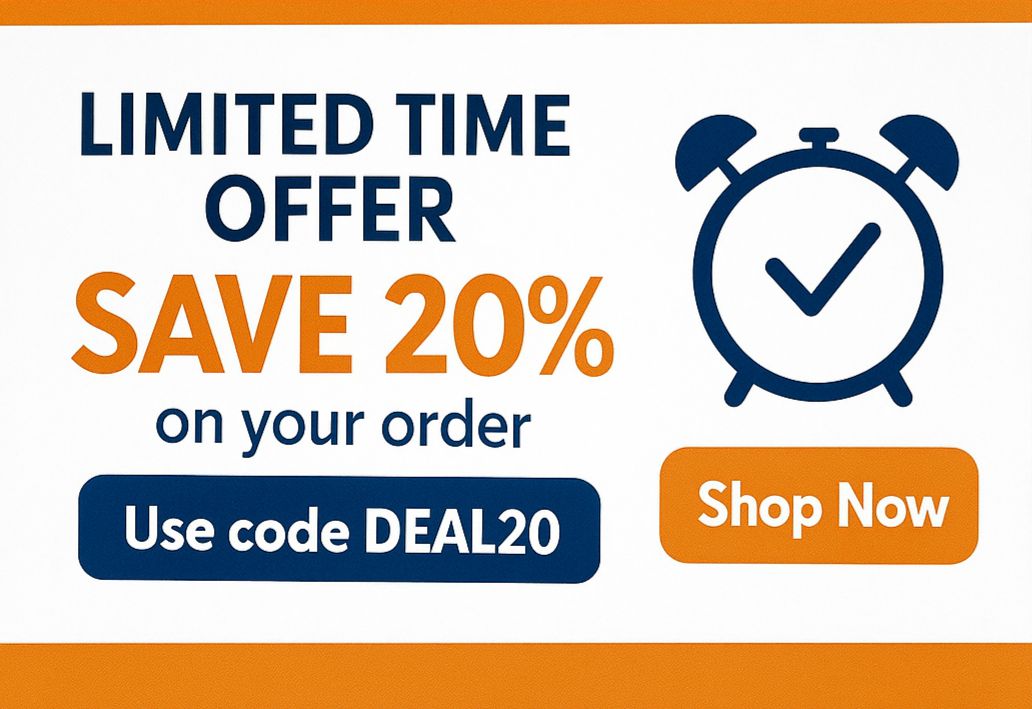 Example: Instead of “Spring HVAC Tune-Up Available” you might get “Save $99 Today & Breathe Easier This Spring” or “Is Your Air Conditioner Ready for 90° Days?”
Tips:
- Keep the audience and benefit front and centre.
- Use action verbs and clear value (“Save”, “Free”, “Limited Time”).
- Test variations on offer, urgency, benefit to see what resonates.
- Retain brand tone and clarity — AI suggestions are draft; revise for brand voice.
2. Crafting Strong Sub-headlines and Supporting Copy
Once your headline grabs attention, sub-headlines and supporting text guide the reader further. AI can help you generate these too.
How to use AI:
- Prompt: “Write 5 different sub-headlines that follow the headline ‘Save $99 Spring HVAC Tune-Up’ and emphasise reliability, quick scheduling, and customer peace of mind.”
- Then: “Write 3 short paragraphs of body copy (~30-50 words each) for this offer, targeting homeowners who value their family’s comfort.”
- Use AI to generate alternative formats: bullet points, question-led copy, testimonial-style copy.
What to watch for:
- Keep copy concise: direct-mail pieces benefit from punchy, readable text.
- Emphasise a single clear offer or call-to-action (CTA).
- Ensure the printed piece has visible CTA (e.g., “Call XXX-XXXX Now!” or “Visit [URL] for your discount”).
- Validate that the AI-generated text fits your format and printing constraints.
3. How to Use AI to Create Direct Mail Offers That Work
The offer itself (what you give the recipient) is crucial. AI can help you generate offer ideas that will work for different segments of your marketing campaign.
Using AI:
- Provide AI with details: business type, audience segment, previous promotions and results (if you have them).
- Prompt e.g.: “Suggest 8 direct-mail offer ideas for a local plumbing company targeting new homeowners in zip code 40205. Include value, urgency and a reason to act now.”
- Ask AI to estimate or rank which offer might drive highest response, given typical audience behaviour (based on your data).
- Example offers: “Free home water-heater inspection (normally $79) for first 100 callers”, “$150 off new sewer-line replacement – this month only”, etc.
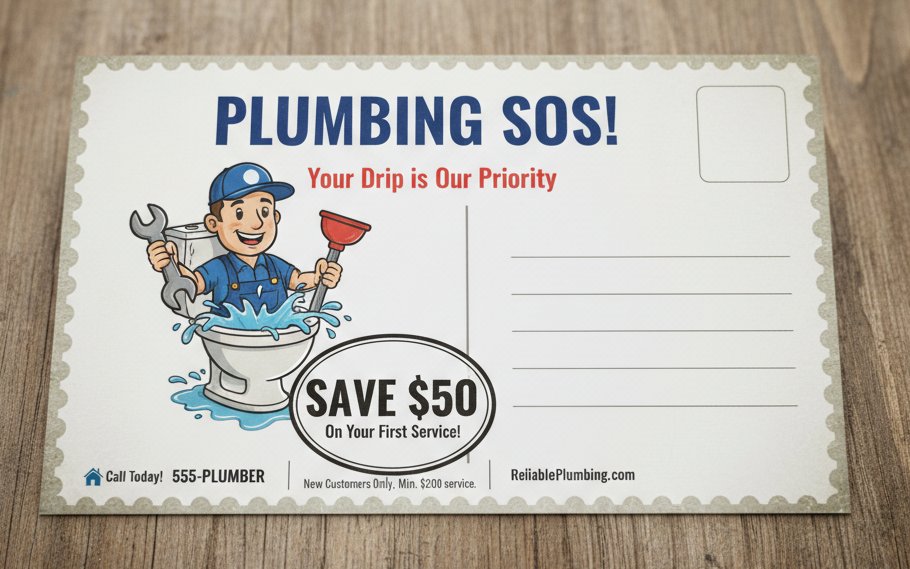 AI Generated Postcard image only given industry, headline, and offer prompt! -------------------->
Testing & optimization:
- Use AI predictions along with your own data to pick top 1-2 offers to mail.
- After the campaign, feed results back into your AI or analytics system so targeting predictions improve.
- Vary offers by segment, using AI to decide which segment gets which offer.
4. Use AI to Get a Content Checklist For Your Mailer Campaign
Beyond headline, sub-headline and offer, a successful piece of direct mail includes key supporting components: credibility, urgency, reason to act, clear CTA, tracking mechanism and branding. AI can help you plan what to include.
Checklist & AI prompts:
- Ask: “List the 10 must-have content elements in a direct-mail postcard campaign for a landscape-maintenance business targeting residential homes.”
- Use AI to generate a “content map” for your piece: e.g., 1) Headline, 2) Offer call-out box, 3) Benefit bullet list (“Why choose us”), 4) Trust signal (testimonial / rating), 5) Urgency/time-limit, 6) Clear CTA with phone / URL, 7) Tracking mechanism (coupon code or QR), 8) Branding/logo, 9) Reinforcement message (secondary benefit), 10) Footer/legal/terms.
- Use AI to write micro-copy for each of those sections.
Example content to include:
- A relevant image or graphic (you can even use AI‐image tools to create custom visuals).
- A unique code or QR that allows you to measure response.
- Social proof: “Over 1,000 yards maintained in Louisville area”.
- Time-sensitive language: “Offer ends October 31”.
- Dual CTAs if needed: “Call now for appointment” and “Visit website to reserve online”.
5. Advice on When to Send Your Mailings
Timing matters. AI can help determine optimal send windows, but there are general best practices too.
General timing considerations:
- Seasonal relevance: For example, HVAC business in early spring; landscaping in early spring or late summer; tax services in Jan-March; home services before major weather changes.
- Frequency & cadence: Avoid sending too often to the same recipients, but regular enough to stay top-of-mind.
- Day of week and mailbox timing: Some research suggests mail arriving early in the week yields better attention.
- Lead time: Allow enough time for printing, addressing, sorting and delivery so that your campaign timing aligns with your offer.
How AI can help:
- Use AI predictive analytics to analyse your historical response data (if you have it) to identify which mailing weeks, days, or demographic segments responded best.
- Use AI to model “optimal send window” based on recipient behaviours and external factors (e.g., local weather, seasonality, known events).
Tip: Combine AI insights with business logic. If you’re a pool-service company, sending a mailer in late February or early March for spring opening makes sense; AI may refine which ZIP codes or homeowner age groups respond best.
6. Marketing Themes & Holidays to Leverage Throughout the Year
A great way to keep your direct-mail campaign fresh is to align offers and creatives with marketing themes, holidays and seasons. Below is a list of ideas and how you could use AI to tailor them.
Themes & Holidays:
| Time of Year | Theme / Holiday | Example Offer / Mailer Idea |
|---|---|---|
| Late Jan – Feb | New Year, Resolve/Refresh | “Start 2026 with a clean slate — spring-clean HVAC/landscaping” |
| Feb 14 (Valentine’s) | Valentine’s Day | “Love your home back — free inspection + upgrade offer” |
| March | Spring-Opening | “Ready for warm weather? Pool/spa opening special” |
| April | Earth Day | “Eco-friendly lawn care: save the planet & your wallet” |
| May | Mother’s Day | “Give mom a home upgrade — discount on interior service” |
| Memorial Day / May | Start of summer | “Grill & chill backyard special: patios, landscaping” |
| June | Father’s Day | “Father-figure deal: free maintenance check” |
| July | Independence Day | “Celebrate with home improvements – patriotic pricing” |
| August | Back to School / End of summer | “Pre-season HVAC tune-up before the heat ends” |
| September | Labor Day / Home improvement push | “Work hard, play hard — home service bundle discount” |
| October | Halloween / Fall prep | “Spook-free home: chimney & HVAC safety check special” |
| November | Thanksgiving / Black Friday | “Thank you home-service special — limited time only” |
| December | Holiday / Year-End | “Wrap up the year with comfort — home systems upgrade offer” |
How AI can support this:
- Ask AI for “12 direct-mail campaign themes for 2026 for a home-services business” and get tailored ideas.
- For each theme, prompt AI to generate custom headlines, sub-headlines and offers (as above).
- Use AI to segment your list by interest or timing and send theme-relevant offers to the right segment.
- Use AI to generate a marketing calendar with reminder triggers: e.g., “Send landscaping mailer 4 weeks before Memorial Day”, and “Send HVAC safety check mailer in early October”.
Why this helps:
- Keeps your campaigns fresh and timely, rather than repeating the same message all year.
- Leverages customer mindset: aligning offers with what people are already thinking about (spring clean, back to school, holiday prep).
- Allows AI-driven variation: you can test themes and see which resonate most with your market and adjust future cycles accordingly.
Use AI To Plan Your Next Direct Mail Campaign
AI is rapidly transforming how businesses approach direct mail. While AI can empower you in your marketing plan in so many ways, there is no replacement for expoert advice from a direct mail profesional. Contact Mail King USA to get help planning your next direct mail campaign or click to get a direct mail quote now if you are ready to print and mail!
Looking for more tips on developing a killer direct mail campaign? Be sure to check out this article full of tips and ideas for your direct mail campaign.