How Does Direct Mail Compare to Other Media Types?

In today’s world of marketing choices, you’ve got plenty of options to pick from: radio, TV, newspapers, email, billboards, internet ads, websites, SEO/SEM, and—of course—good old direct mail like postcard mailings or letter campaigns. The question is: are they all created equal? The short answer: no. The key is knowing what each medium does best, when it works, and how it stacks up against the others—especially if you want response, not just awareness.
Let’s walk through the big players: Branding media (think billboards, TV, magazines), Search media (web, SEO), Digital direct response (email, social, PPC), and then the one we favor: direct mail. We’ll assess pros and cons of each, and show why direct mail often wins—or at least deserves a heavy place in your strategy.
1. Branding-Oriented Media (Billboards, TV, Magazines)
What they do best
These are the big, bold channels: giant signs on the highway, 30-second TV spots, glossy magazine ads. Their purpose: to create awareness, to establish presence, to build your brand over time. They say “we exist”, “we’re credible”, “we’re here”.
Key Idea!
"Investing in radio, TV, magazines, billboards … when you need a fast return is a bad idea. Those are each BRANDING mediums NOT direct response.”
 That nails it: when you want quick leads, these may not be your best choice.
Pros
- Huge reach. You’re exposing your brand to large audiences, often in a splashy way.
- Brand prestige. Big budget ads lend “we’re serious” credibility.
- Useful for long-term brand building: when your goal isn’t immediate sale but reputation.
Cons
- Costly: production + airtime/placement add up quickly.
- Weak direct response: these media are not built for “call now” or “click here”—they create recognition, not urgency.
- Hard to track precisely: measuring ROI can be tricky. Did that billboard = new customer? Harder to know.
- Time-lag to results: branding might pay off in 12-24 months, not next week.
Summary
Branding media has its place when your business is established and you want to reinforce your identity. But if you’re looking for immediate action, leads, conversions—other media might serve you better.
2. Search & Digital Media (Websites, SEO, PPC, Social)
What they do best
These channels are about being found, being relevant, being in the first place when someone is looking. Your website, your search engine ranking, your PPC ads—all serve the intent-driven user. Remember, the web is the new SEARCH directory and NEWS medium, replacing newspapers and yellow pages. So if someone is actively searching, digital is your friend.
Pros
- Instant deployment: you can spin up campaigns quickly, change messaging fast.
- Scalability: digital can handle big and small budgets and reach a broad or very narrow audience.
- Tracking & analytics: you get clicks, conversions, impressions—in real time.
- Good for capturing intent: people who are searching are often closer to buying.
Cons
- Saturation & competition: everyone races for the same clicks, driving costs up.
- Short attention spans: banner ads get ignored; users may scroll past or block.
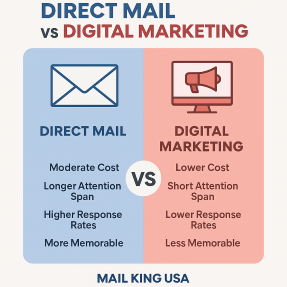
- Ad fatigue & privacy concerns: some users distrust digital ads, are annoyed by them. For example, a study found 60% of consumers more easily remember direct mail than digital ads: “60% say direct mail ads are easy to remember when ready to make a purchase, vs 44% for digital ads.” (The Financial Brand)
- Lower perceived value: An email or ad lacks the physical presence, the tactile feeling.
- Often focused on awareness or clicks—not always on closing a sale.
Summary
Search & digital channels are great when you want to meet people where they’re already looking. They’re flexible and measurable. But if you’re trying to stand out, get deeper engagement, or overcome digital noise, they often fall short by themselves.
3. Direct Mail (the Tactile, Targeted Touch)
Now let’s bring this home: direct mail. This is the medium we believe deserves serious strategic weight, especially if you want response, not just noise.
 What direct mail does best
– It delivers something physical—a postcard, letter, catalog—that lands in a mailbox, in the home.
– It commands focused attention: because fewer marketers rely on it compared to digital, direct mail pieces can stand out. For example: “Campaigns including direct mail are 27% more likely to deliver top-ranking sales performance, and 40% more likely to deliver top-ranking acquisition levels, versus campaigns without mail.” (sendoso.com)
– It builds trust and memorability: a well-designed piece sits on desks, refrigerators, gets passed among household members. A study found 72% of consumers regularly read or look at ads in the mail, and that direct mail ads were easier to recall when ready to make a purchase. (The Financial Brand)
– It can be highly targeted with a good mailing list and personalized: you can aim for specific demographics, ZIP codes mailings, homeowners, new movers, radius mailings and the like.
Pros
- High response rates: For some direct mail campaigns, response rates can be 5–9× those of email. (PDC Graphics)
- Less clutter: Your mail piece isn’t competing with thousands of pop-ups, banner ads, spam emails. It lands in a mailbox.
- Tangible credibility: A quality piece gives the brand weight, legitimacy.
- Extended exposure: Unlike a fleeting ad, a direct mail piece may sit on a kitchen table for days—or be kept for future reference. For example, in one study the average time spent on direct mail was higher than on digital ads (1.6 minutes vs 1.1 minutes) and many recipients saved or revisited pieces. (The Financial Brand)
- Works well in multichannel strategy: Direct mail can drive online behavior; you can incorporate QR codes, landing pages, combined digital follow-ups. For example, combining direct mail with email leads to purchases six times larger than email alone. (Thryv)
- Breaks through digital fatigue: As inboxes fill and ad blindness grows, physical mail offers a refreshing interrupt. The MIT Sloan article noted direct mail can help brands “cut through the clutter” and reach consumers experiencing digital fatigue. (MIT Sloan Management Review)
Cons (and how to mitigate them)
- Longer lead time: You’ll need time for printing, mailing, delivery. Mitigation: plan ahead, integrate with digital for follow-ups. Also, be sure to work with the right mai house. A great direct mail company like Mail King USA can turn out a mailing in just 2-4 days. Now that is fast!
- Higher upfront cost: Printing + postage + design cost more than many email sends. Mitigation: use targeted lists and test formats to optimize ROI.
- Tracking can be more complex: Digital conversions are easy; tying sales back to a postcard may require more effort. Mitigation: use unique URLs, QR codes, custom landing pages, unique offer codes.
- Sustainability concerns: Some brands worry about paper, waste. Mitigation: use recycled stock, plant-based inks, and messaging that supports the eco-side of print.
Summary
When you’re looking for response, engagement, and memorable impact, direct mail often outperforms. Especially when you integrate it smartly with digital channels, you maximize your impact. It’s not “print vs digital”—it’s “print and digital done right”.
4. Comparing the Media: A Strategic Side-by-Side
| Medium | Best For | Response Speed | Cost Relative | Tracking & Analytics | Strengths | Weaknesses |
|---|---|---|---|---|---|---|
| Branding Media (Billboard, TV) | Awareness, brand prestige | Slow | High | Low-moderate | Big splash, wide reach, brand credibility | Weak direct response, high cost, low precision |
| Search/Digital (Web, PPC, Social) | Intent capture, quick campaign deployment | Fast | Moderate to Low | Very High | Quick start, scalable, very measurable | Oversaturated, often ignored, ad fatigue, lower trust |
| Direct Mail | Targeted response, tactile engagement | Moderate | Moderate | Moderate-High (with effort) | Tangible, high engagement, cutting through digital clutter | Longer lead time, higher upfront, requires smart tracking |
From this chart you can see direct mail sits in the sweet spot: not as costly or slow as big branding buys, yet more impactful than many digital-only tactics in terms of response and memory.
5. Why Direct Mail Should Be At the Core of Your Strategy
Given the above, let’s zero in on why a business—especially one looking for measurable results, like leads or sales—should strongly consider making direct mail a primary part of their marketing mix.
a) Real-world results & research
- One study showed campaigns that included direct mail were 27% more likely to deliver top-tier sales performance. (sendoso.com)
- Response-rate data: direct mail can be 5–9 times more effective than email for getting responses. (PDC Graphics)
- Another report found 72% of consumers regularly examine ads in the mail, and 60% said direct mail ads were easier to remember when ready to make a purchase (vs 44% for digital). (The Financial Brand)
- In a world of digital fatigue and rising cost per click, direct mail is resurging. (MIT Sloan Management Review)
These numbers tell the story: you get more attention, more response, potentially better ROI for certain campaigns.
b) Personalization & targeting
Unlike generic broadcast media, direct mail lets you get smart: you pick specific ZIP codes, homeowner lists, new-mover lists, income thresholds, etc. The result: you reach the right house, not just many houses. Combine that with a tailored message and you’re speaking to a specific person with a specific need.
c) Physical presence = memory effect
When a recipient holds a postcard, letter, magnet, catalog, it engages more senses than a banner ad or email. It sits on desks, refrigerators, tables. That “dwell time” matters. Studies show people spend more time with direct mail pieces than with digital ads and are more likely to revisit them. (The Financial Brand)
d) Integration multiplier
Do not view direct mail as at odds with digital—view it as complementing digital. For instance: send a direct mail piece, then follow up via email or digital ad targeting that same recipient. The combined effect is bigger: one study said combining email with direct mail led to purchases six times larger than email alone. (Thryv)
Direct mail acts as the anchor that pulls someone in; digital amplifies it with immediacy, tracking, and scalability.
e) Cut through digital noise
With so many digital messages, people are numb: inboxes overflowing, ad-blockers, scroll fatigue. Direct mail escapes that noise. According to experts, direct mail is making a comeback in part because it can “cut through the clutter”. (MIT Sloan Management Review)
6. When Digital (or Branding) Makes More Sense
While we’re pro direct mail, we have to be realistic: there are times when other media shine.
• If you need instant, broad reach globally
Digital ads and search can fire up within minutes and reach many people across regions. If your product launch is global, you might pair digital mass reach with other channels.
• If you’re building long-term brand equity
Branding media (TV, billboard) can build prestige, trust, and broad awareness that direct mail alone may not. If your market is saturated and you want to dominate mind-share, brand media may play a role.
• If your audience is very young and mobile-first
Digital channels may resonate better with Gen Z or mobile-native audiences who spend less time reading mail. So your segmentation matters.
• If you have very tight budgets and cannot afford print/postage
Email and social may allow smaller bets. Though direct mail may have higher ROI, if you can’t fund it, a smart digital campaign may still serve.
But—and here’s the key—even when you go digital or branding, layering direct mail in the mix boosts impact. The question isn’t “should we use direct mail or digital?” but rather “how do we bring direct mail into our strategy so we maximize response?”
7. Best Practices for Using Direct Mail (to Maximize the Benefit)
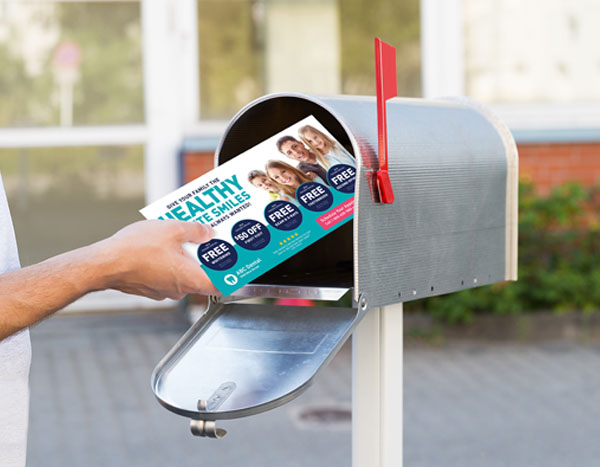 Since direct mail is only powerful when used well, here are some tips to extract the most value:
- Target well – Use smart lists: homeowners in certain ZIPs, recent movers, high-income households, etc.
- Design matter – Make the piece eye-catching, professional. The tactile quality counts.
- Strong offer & call-to-action (CTA) – You need the “What do I do next?” piece to be obvious: redeem this, call now, visit the landing page, scan this QR code, etc...
- Integrate with digital – Use unique URLs, QR codes, landing pages tied to that mail piece. Then follow up digitally to the same audience.
- Test, measure, iterate – Use small test runs before scaling. Track cost per acquisition (CPA), response rate, returns. Studies show that direct mail ROI can range 85–112 % on average, outperforming many digital channels. (PDC Graphics)
- Use dwell time – A mail piece can sit on a fridge or desk; consider designs or offers that invite revisit (e.g., clip-out coupon, magnet postcard).
- Be consistent – Repetition builds familiarity. Don’t treat direct mail as a one-off; make it part of your cadence.
- Mind sustainability – If environmental perception is important to your brand, use recycled materials and highlight sustainable practices.
8. Where to Go From Here
So what’s the takeaway? If you’re serious about marketing that works—capturing leads, driving conversions, engaging real people—then you need to pay attention to direct mail. Here’s a quick summary:
- Branding media is great for awareness, not so much for fast action.
- Digital media is fast, scalable, measurable—but increasingly noisy, and often less memorable.
- Direct mail offers physical presence, strong targeting, high engagement, and—when done right—better response rates.
In short: make direct mail your strategic advantage, not an after-thought. Use it to cut through the digital clutter, deliver your message in the homes of your target audience, and anchor your other marketing efforts (digital or otherwise). Pair it smartly with digital for tracking and amplification, and you’ll get both the stickiness of physical mail and the speed of digital.
Your mailbox is still a powerful battleground—for the brands that show up with something smart, targeted, and tangible, the payoff is real.
Ready to setup your mailing campaign? Get a direct mail qoute now!

