72-Hour GOTV Blitz: Using Direct Mail to Win Your Election
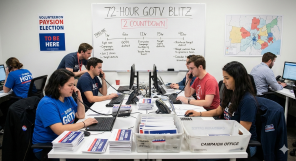 In the high-stakes world of political campaigning, the final 72 hours before the polls close is often where elections are won or lost. While digital ads flash across screens and phone banks hum, a tangible, high-impact tool is often the deciding factor in mobilizing the "likely-but-lazy" voter: The Political Postcard.
In an era of increasing digital saturation, the "digital fatigue" of voters is a constant hurdle. To cut through the noise, successful campaign managers rely on the mailbox to deliver the final knockout blow. Here is how to execute a 72-hour Get-Out-The-Vote (GOTV) blitz that turns intention into action.
Why Direct Mail is the Ultimate Voting "Closer"
Direct mail remains one of the most effective channels for high-stakes communication. Data from the Association of National Advertisers (ANA) consistently shows that direct mail ROI outperforms many digital channels, often yielding a significantly higher response rate for targeted lists.
In a political context, this isn't just about reach—it’s about trust. According to USPS research on voter behavior, a high percentage of voters perceive physical mail to be more reliable and less prone to the "noise" of social media misinformation. When a voter holds a political postcard in their hand, your message becomes a physical reminder sitting on their kitchen table on the very morning they need to head to the polls.
The 4-Step Strategy for a 72-Hour Voter Blitz
1. Segment Your "Turnout Targets"
In the final 72 hours, the window for persuasion has closed. Your goal now is strictly mobilization. Focus your direct mail postcard efforts on your "base" and "low-propensity supporters."
- The Universe: Focus on voters with high candidate support scores but inconsistent voting histories.
- The Goal: Remove every friction point between the voter and the ballot box.
 2. Leverage "Social Pressure" Messaging To Get More Votes
Research from institutions like the Center for Voter Information has long demonstrated that "Social Pressure" mailers can measurably increase voter turnout. A simple, professional reminder that "Your voting record is public" or "Your neighbors are counting on you" creates a psychological nudge that digital ads cannot replicate.
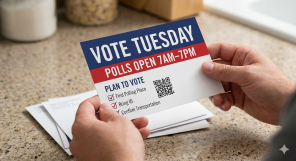
Pro Tip: Include a "Plan to Vote" checklist on the back of the card. When a voter mentally or physically checks off their "time to vote" and "transportation plan," they are significantly more likely to follow through.
3. Design Postcards for the "3-Second Rule"
Your postcard has approximately three seconds to move from the mailbox to the "keep" pile. Timeless design principles dictate high-contrast, minimalist layouts:
- Front Side: A clear, bold "VOTE TUESDAY" or "POLLS OPEN 7AM–7PM."
- Back Side: A high-visibility QR code that links directly to a "Find Your Polling Place" tool.
4. Navigate the USPS Political "Red Tag" System
Timing is everything. For a 72-hour blitz, your mail must be in-home by the Saturday or Monday before Election Day. To ensure this happens, your campaign must utilize USPS Tag 57.
- The "Red Tag": This is a specific USPS identifier for Political Campaign Mail that signals to postal workers that the mail is time-sensitive.
- SCF Entry: To guarantee that tight window, work with a partner like Mail King USA who can perform "Sectional Center Facility" (SCF) entry, dropping your mail closer to the final destination to bypass regional processing delays.
The Reliability Factor: Combatting Misinformation
 In the modern political landscape, voters are bombarded with rapid-fire digital messaging that is often difficult to verify. Direct mail serves as a "verified" source. Because physical mail requires a registered sender and a physical production process, voters often view it as a more legitimate form of communication.
By providing clear, factual information about polling locations and ID requirements, you establish your campaign as the authoritative voice in the final hours.
Don't Leave Your Turnout to Chance
A 72-hour GOTV blitz isn't just about sending mail; it's about being the final voice your supporter hears before they walk out the door. By combining precision targeting with the psychological power of a physical postcard, you can bridge the gap between "planning to vote" and "casting a ballot."
Secure Your Spot in the Mailbox for the Next Election
Get a custom quote for your political postcard campaign at Mail King USA today.
Frequently Asked Questions (FAQ)
Q: What is the average response rate for political direct mail?
A: While response rates vary by district and race, political mail historically sees a much higher engagement rate than digital ads. According to industry benchmarks, direct mail can achieve a 5–9% response rate depending on the list quality, compared to less than 1% for most display ads.
Q: What is USPS Tag 57 and why is it required for political mail?
A: USPS Tag 57 is a red "Political Campaign Mailing" tag used to identify and prioritize political mail within the postal system. Using this tag ensures your GOTV postcards receive specialized handling and are not delayed by standard marketing mail volumes during peak election season.
Q: Is it better to send a letter or a postcard for a GOTV campaign?
A: For a 72-hour blitz, postcards are superior. Because they have no envelope to open, your message (like polling location and date) is seen instantly. Letters are better suited for early-season fundraising or long-form policy explanations where a more personal, "official" tone is required.
Q: How do you target low-propensity voters with direct mail?
A: We use advanced voter file data to filter for residents who are registered with your party but have missed the last two local or midterm elections. This "low-propensity" segment is the most cost-effective group to target for a GOTV blitz because a simple physical nudge is often all they need to go to the polls.
Q: Can I use QR codes on my political postcards?
A: Yes. QR codes are a bridge between print and digital. For political mail, we recommend using QR codes to link directly to a "Polling Place Locator" or a "Check Your Registration" page to make the voting process as frictionless as possible for the recipient.