The 2026 Advertising Pivot: Why the "Tactile Premium" is Driving Ad Spend
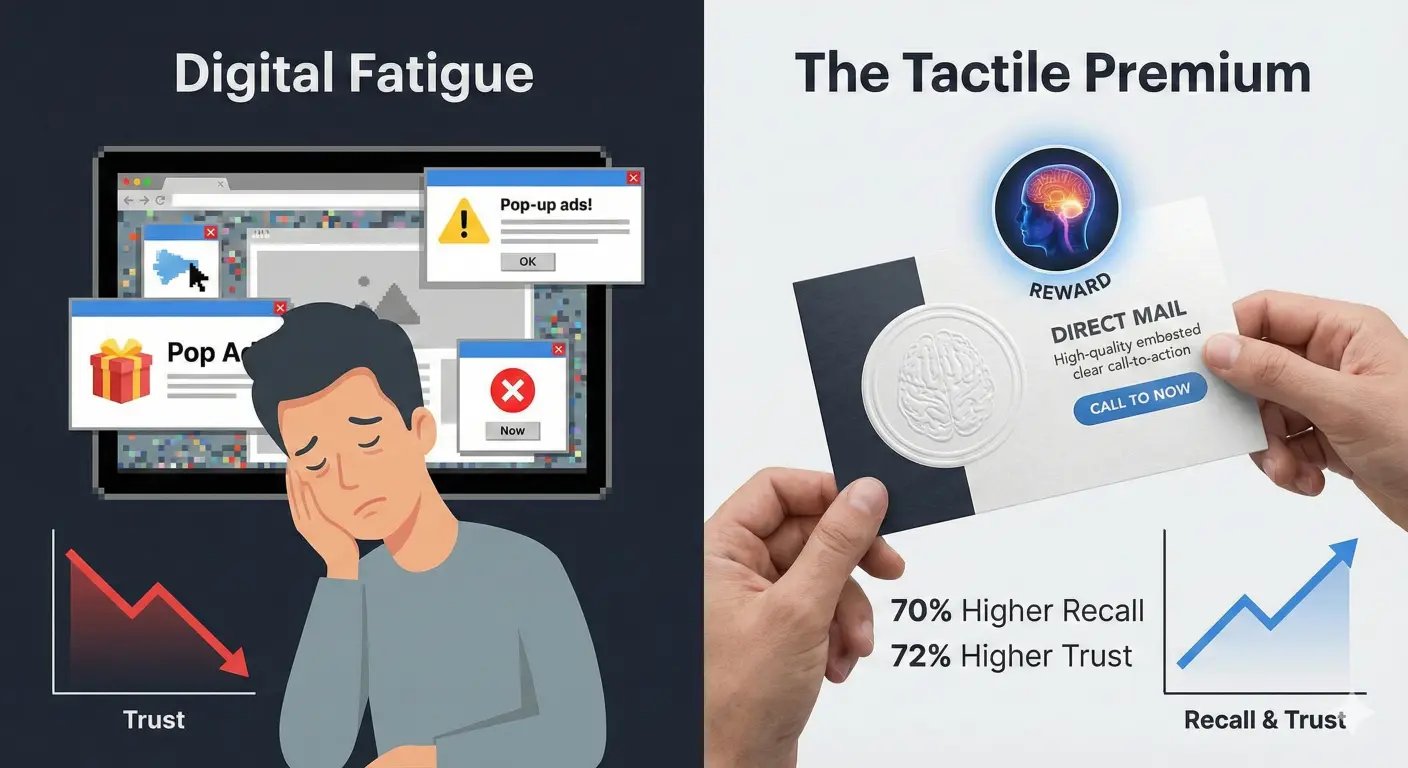 Forget the doom-and-gloom headlines. In 2026, the economy isn't shrinking—it’s stabilizing. But consumer behavior has shifted drastically. We have entered the era of "Digital Fatigue."
After years of being bombarded by AI-generated content, spam emails, and invasive tracking, consumers have built a fortress around their digital lives. The smartest businesses aren't trying to breach that fortress with more clicks; they are walking right through the front door with physical mail.
This "flight to quality" is why advertising spend is surging in the direct mail sector. It’s no longer just about "getting the word out"; it’s about using a trusted channel to secure high-value relationships.
The Neuroscience of "Real": Why Paper Beats Pixels
The resurgence of direct mail isn't nostalgia; it's science. A 2025 study referenced by the Association of National Advertisers (ANA) confirmed that the human brain processes physical media differently than digital.
- The "Tactile Premium": Touching a physical object activates the ventral striatum, the brain's valuation center. This leads to a 70% higher brand recall for direct mail compared to digital ads.
- Deep Trust: In an age of deepfakes, paper implies permanence. Research from Lob’s State of Direct Mail Report indicates that 72% of consumers trust direct mail more than digital ads when making purchasing decisions.
- The Attention Span Victory: The average lifespan of a digital ad is seconds. The average lifespan of a postcard in a household is 17 days.
The Great Digital Rebalancing: Why 2026 is the Year of the Mailbox
We are witnessing a massive structural shift in advertising budgets. For the first time in over a decade, the "digital-only" mantra is being challenged by a "physical-first" reality. As digital costs soar and consumer trust in screens hits an all-time low, the most sophisticated brands in the world are reallocating their dollars to the one place that isn't crowded: the mailbox.
The Stats: The Spending Surge is Real
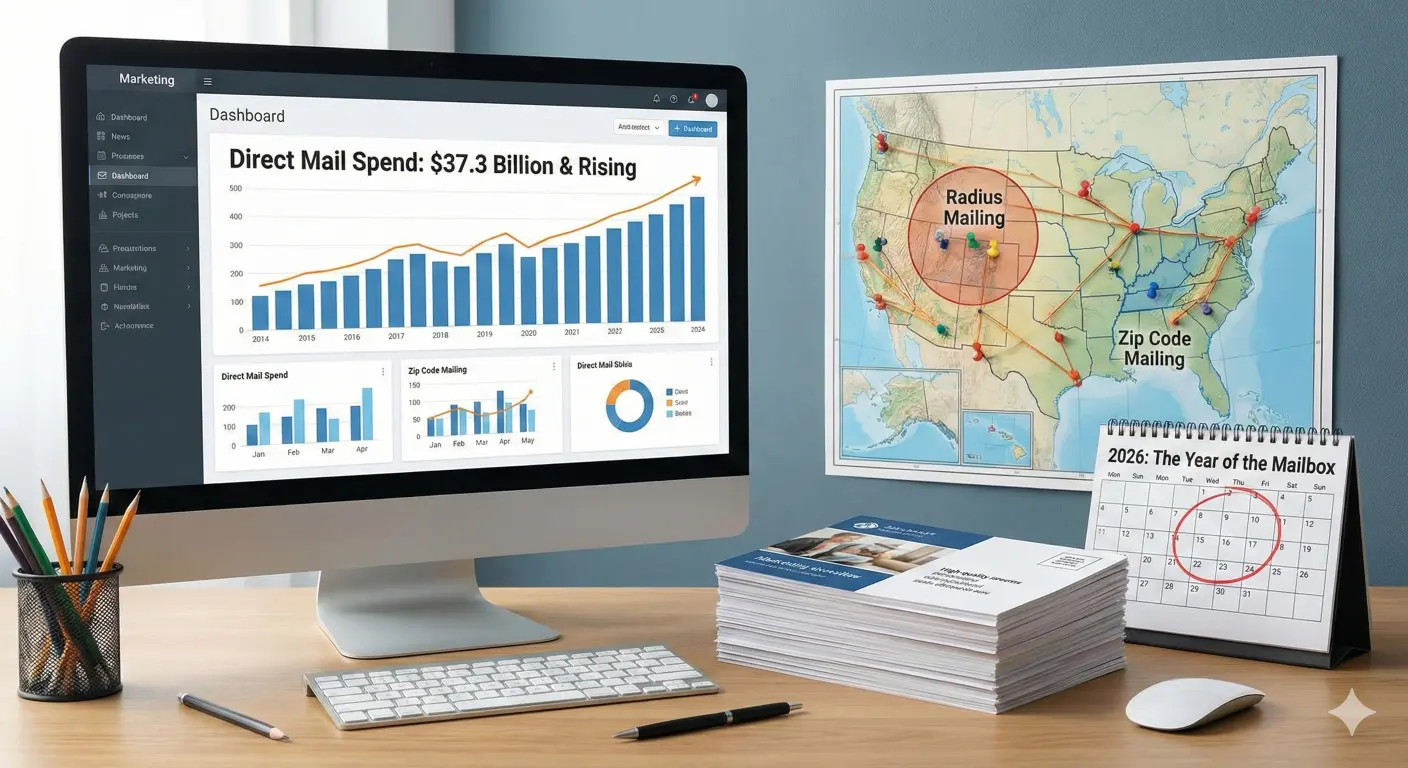 Recent market data proves that direct mail isn't just surviving; it’s becoming the flagship channel for high-growth companies.
- The Investment Boom: In 2025, U.S. brands increased their direct mail spending to $37.3 billion, reversing years of decline. This trend has accelerated into 2026 as 82% of enterprise marketing executives report significantly increasing their direct mail budgets (Source: Lob State of Direct Mail).
- The Shift Away from Digital: The exodus from traditional PPC (Pay-Per-Click) is fueled by diminishing returns. With nearly 60% of all search queries now ending in "zero clicks," brands are diversifying. Thousands of marketers are shifting spend from over-leveraged Google and Meta ads into offline strategies that offer a clear path to the home (Source: Spectrum Marketing).
- ROI Superiority: When it comes to the bottom line, the numbers are undeniable. Direct mail currently boasts an average ROI of 29%, compared to just 23% for paid search and 16% for online display ads (Source: Statista).
Why Companies are Abandoning "Digital-Only"
The "move away from digital" isn't about ignoring the internet; it’s about acknowledging Digital Fatigue.
- CPA Stability: While digital Cost Per Acquisition (CPA) fluctuates wildly based on algorithm changes, direct mail postcards offer predictable, stable costs. For high-value services, direct mail to house lists delivers a CPA of $50–$150, which is often lower than the competitive bidding wars of Google Search (Source: AIIM).
- The "Abandoned Cart" Solution: In 2025, a landmark study in the MIT Sloan Management Review found that for e-commerce and service brands, direct mail delivered a Return on Ad Spend (ROAS) of 55%, dwarfing Google's 21.4% and Facebook's 4.7%.
- Local Dominance: Companies are realizing that zip code mailing provides a level of geographical "ownership" that digital geofencing simply cannot match. By pairing this with radius mailing, local businesses are creating a "fortress" around their most profitable service areas.
"This isn't about replacing digital marketing. It's about using the right channel that helps marketers achieve the best ROI. In 2026, the mailbox is the only place left where you have 100% of the customer's undivided attention." — Industry Analysis, WhatTheyThink
Precision Over Volume: The "Route Density" Strategy
In the past, marketing was about volume. In 2026, it is about precision. Rising postage costs have actually helped the industry by forcing marketers to stop "spraying and praying" and start targeting with military-grade accuracy.
For local service businesses, the most profitable metric today is Route Density. It is far cheaper to service 50 homes in one neighborhood than 50 homes spread across the city.
- Radius Mailings: This is the secret weapon for contractors. By targeting the closest 200 neighbors around your current job site, you leverage "social proof." When neighbors see your truck and receive your card, trust skyrockets.
- Zip Code Mailings: For retail and broad service offers, filtering by zip code ensures you only pay to reach areas that match your ideal income demographic, eliminating waste.
Case Study: The "Omnichannel" Multiplier
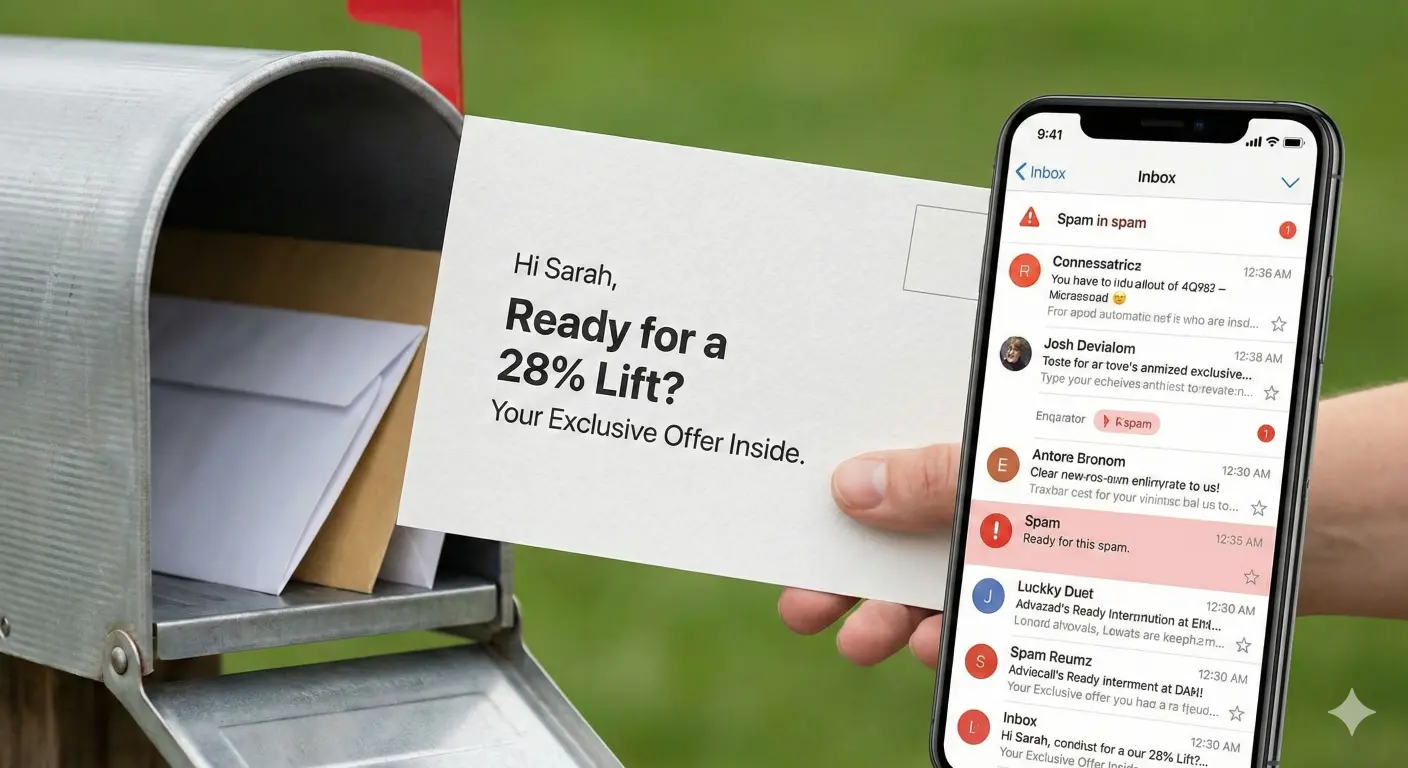 You don't have to choose between digital and physical. The most powerful campaigns in 2026 use Integrated Direct Mail.
A recent case study highlighted by MarketingSherpa followed a mid-sized HVAC company. They stopped sending standalone emails (which had a 0.5% open rate) and switched to a triggered campaign.
- Step 1: A homeowner visits the website.
- Step 2: A Direct Mail Postcard is automatically mailed to their home within 48 hours.
- Result: The campaign saw a 28% increase in conversion rates compared to digital retargeting alone.
The data is clear: Physical mail primes the brain, making your eventual digital follow-up significantly more effective.
Don't Get Left in the Spam Folder
The economy of 2026 favors the bold and the tangible. While your competitors fight for scraps in an overcrowded digital feed, you have the opportunity to own the kitchen counter.
Get A Quote On Direct Mailing Services
Frequently Asked Questions
Is direct mail actually effective for younger generations (Gen Z/Millennials)?
Surprisingly, yes. Data from USPS Delivers shows that 75% of Millennials value receiving personal mail. Because they grew up in a digital-native world, physical mail feels "novel" and "special" rather than "junk," leading to higher engagement rates than older demographics.
What is a "good" mailing response rate?
The days of 1% being acceptable are over for house lists. According to the Data & Marketing Association, average response rates for house lists (existing customers) are hovering between 5% and 9%. Prospect lists (cold traffic) typically see 1% to 3%, which is still significantly higher than the 0.1% average for email.
How can I track the ROI of my postcards?
Tracking is no longer a guessing game. We recommend using "Digital Bridges":
- QR Codes: Unique codes that track exactly who scanned the card.
- pURLs (Personalized URLs): yourwebsite.com/Steve allows you to see exactly when a specific lead visits.
- Call Tracking: A unique phone number on the card that forwards to your main line but records the lead source.
Is "Every Door Direct Mail" (EDDM) better than a targeted list?
It depends on your business. If you are a pizza place or a laundromat where everyone is a potential customer, every door postcard mailers are cost-effective. However, for niche services (like pool installation or luxury landscaping), a targeted list is superior because you avoid paying to mail renters or low-income households who cannot afford your service.
How many times do I need to mail a prospect?
The "Rule of 7" still applies, but in 2026, we see the "breakthrough" often happen around the 3rd mailing. A single postcard proves you exist; a sequence of three proves you are a reputable, established brand.
Isn't direct mail bad for the environment?
The industry has adapted. Modern direct mail is highly sustainable. Most reputable mail houses now use papers certified by the Forest Stewardship Council (FSC) and biodegradable inks. Furthermore, because data targeting is so precise in 2026, "junk mail" (waste) has been drastically reduced—we only mail people who actually want the offer.
How long does it take to launch a direct mail campaign?
With digital printing technology, it's faster than ever. Once the design is approved, most Bulk Direct Mail Postcard campaigns can be printed and dropped in the mail stream within 2 to 4 business days.
