Back-to-School Marketing: Quick Wins to Boost Sales
 Summer’s ending—parents are spending. Back-to-school is the second-biggest shopping season of the year.
According to the National Retail Federation, in 2025, U.S. families spent an astounding $39.4 billion on K–12 back-to-school shopping.
2026 is shaping up to be even better.
What does back to school spending look like in 2026?
The 2026 back-to-school opportunity is even greater. U.S. families with children in kindergarten through 12th grade expect to spend a record $43.3 billion during the 2026 back-to-school season. The average family plans to spend approximately $863.86, including:
- $293.11 on electronics
- $250.29 on clothing and accessories
- $174.01 on shoes
- $146.45 on school supplies
The average household now plans to spend $858, covering clothing, shoes, school supplies, and electronics!
More than just school supplies and new outfits
Savvy businesses know that back to school spending extends beyond school supplies. It creates opportunities for restaurants, healthcare offices, salons, tutoring centers, gyms, retailers, home-service companies and other local businesses.
A few ideas below to get your creative juices flowing...
| Business | Campaign idea | Possible offer |
|---|---|---|
| Pediatrician | School and sports physical campaign | Priority appointment or new-patient welcome kit |
| Dentist/orthodontist | Back-to-school smile check | Exam or consultation offer |
| Tutoring center | Academic readiness assessment | Free evaluation |
| Restaurant | Busy-family dinner campaign | Kids eat free or family meal bundle |
| Salon/barbershop | First-day haircut campaign | Student haircut package |
| Clothing retailer | School wardrobe event | Percentage discount or bundle |
| Gym | Parents’ back-to-routine campaign | Free introductory week |
| Home services | “Get the house back in order” campaign | Seasonal service discount |
| Photographer | First-day or senior portraits | Session credit |
| Daycare/after-school program | Enrollment campaign | Registration discount |
When does back to school season start and end?
Most families shop between late July and early September, with many starting even earlier to take advantage of summer sales.
A rough marketing timeline might look like this:
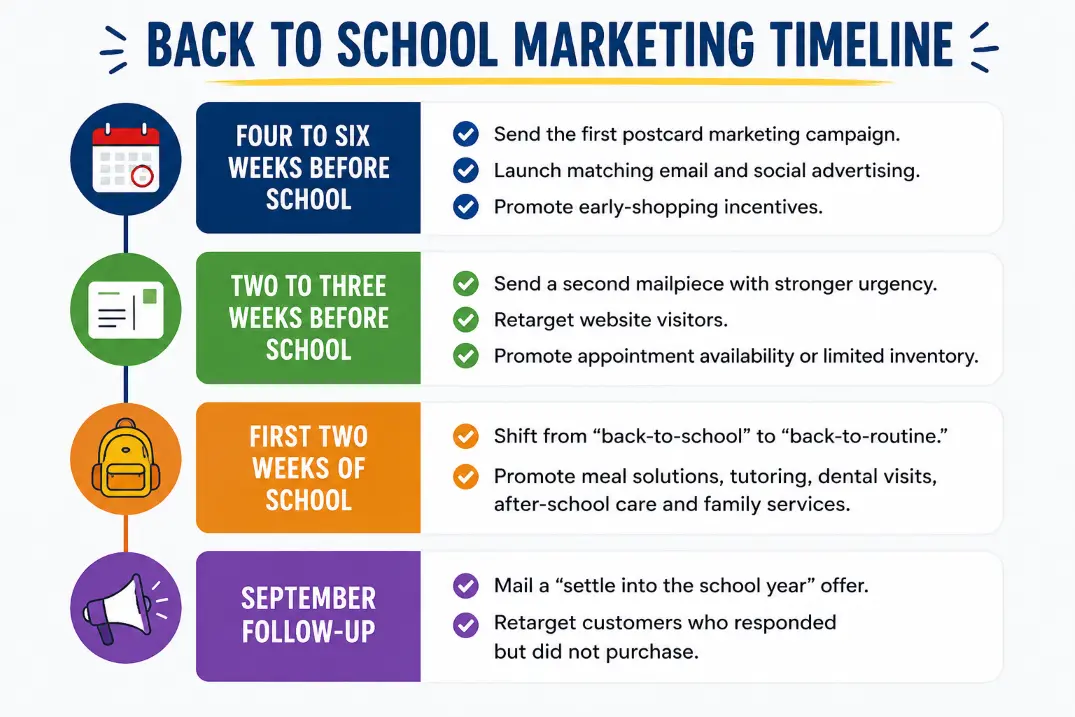
- Four to six weeks before school
- Send the first postcard marketing campaign.
- Launch matching email and social advertising.
- Promote early-shopping incentives.
- Two to three weeks before school
- Send a second mailpiece with stronger urgency.
- Retarget website visitors.
- Promote appointment availability or limited inventory.
- First two weeks of school
- Shift from “back-to-school” to “back-to-routine.”
- Promote meal solutions, tutoring, dental visits, after-school care and family services.
- September follow-up
- Mail a “settle into the school year” offer.
- Retarget customers who responded but did not purchase.
Here’s how any business can cash in—fast, smart, and profitably.
1. Sell the Obvious (and Win Big)
- Clothes, shoes, supplies: Recession-proof. Bundle & save.
- Electronics: Biggest spend category. Laptops, tablets, chargers—push durability + student discounts.
Tactic: Mail postcards with “Back-to-School Survival Kits” (e.g., laptop + case + mouse for $299).
2. Marketing Beyond the Backpack
You don’t need school supplies to win:
- Restaurants: “Free kids’ meal with adult entrée—first week of school.”
- Auto shops: “Carpool Ready Tune-Up: $49.”
- Home services: “Study Space Refresh—20% off desks & lighting.”
- Salons: “Parent Glow-Up: $20 off cuts before Meet-the-Teacher.”
- Tutoring / gyms / cleaners: All fair game. Tie it to “new year, new you.”
Tactic: Use QR codes on mailers → instant booking or flash sale.
3. Sucessful Marketing in a Tight Economy
Shoppers want deals + necessity. Deliver both:
- 55% hunt coupons. Include tear-off coupons or BOGO offers.
- 25% buy only what’s on school lists. Stock & promote “List-Approved” items.
- Partner with schools: Co-branded mailers, supply drive donations, PTA sponsorships.
Tactic: Target high-spend zip codes with Mail King USA’s precision data.
4. Direct Mail = Your Secret Weapon
- 85% open rate (vs. 20% email).
- Tangible = trusted.
- Fastest turn times, lowest prices, best data.
Tactic: Launch 1-week campaigns in late July. Use bold visuals: apples, buses, fresh starts.
Seven Back-to-School Marketing Mistakes to Avoid
- Waiting until school has already started.
- Trying to promote too many offers at once.
- Using an offer that is too weak.
- Mailing to the wrong households.
- Omitting an expiration date.
- Sending only one marketing touch.
- Failing to track responses.
Ready to reach local families before the school year begins?
Mail King USA can help you choose the right audience, create your postcard, print it and deliver it to homes in your target area. Request a free mailing estimate and campaign recommendation.
Get a Back to School Mailing Quote

Frequently Asked Questions About Back-to-School Marketing
1. When should back-to-school marketing begin?
Most successful campaigns begin in late June or early July, before families finalize their shopping plans. Mailing your first postcard 4–6 weeks before school starts gives your business the best chance to stand out.
2. What businesses benefit from back-to-school promotions?
Retail stores, restaurants, pediatric offices, dentists, tutoring centers, salons, fitness centers, childcare providers, home service companies, and many other local businesses can all capitalize on the increased spending and busy schedules of families during back-to-school season.
3. Is August too late to start a campaign?
Not at all. While earlier is better, many families continue shopping throughout August and even after school begins, making it a great time for reminder promotions and last-minute offers.
4. What makes a good back-to-school offer?
The best offers solve a problem, save families money, or make life more convenient. Discounts, free gifts, bundled services, and limited-time promotions tend to generate the strongest response. When it comes to offers, dont hold back. You need to stand out from the competition.
5. How many postcards should a business mail?
For most campaigns, sending at least 1,000 postcards is essential to get your cost per piece down when outsourcing your mailing. Prices continue to drop quickly as you approach 10,000 mailers and then sort of level off. However, if you are mailing in house, then a targeted mailing of just a few hundred postcard can still have a big impact if you use an in house customer list.
6. Should I use EDDM or a targeted mailing list?
EDDM works well for businesses that serve nearly every household in a neighborhood, while targeted mailing lists are ideal when you want to reach specific demographics, such as families with children, new movers, or higher-income households.
7. How often should postcards be mailed?
A series of two or three mailings spaced about 2–3 weeks apart is often more effective than a one-time campaign. Repeated exposure helps build recognition and improves response rates.
8. What postcard size works best?
Oversized postcards, such as 6" × 9" or 6" × 11", typically attract more attention than smaller formats because they stand out in the mailbox and provide more space for your message and offer.
9. How can I track responses from direct mail?
Use unique promo codes, QR codes, personalized landing pages, dedicated phone numbers, or coupon redemption codes to measure how many customers respond to your campaign.
10. Should my postcard include a QR code?
Yes. A QR code provides an easy way for recipients to visit your website, schedule an appointment, claim an offer, or learn more using their smartphone, making it easier to bridge print and digital marketing.
11. Can back-to-school promotions continue into September?
Absolutely. Many families continue shopping after school starts, and September is an excellent time to promote services and products that help families settle into new routines.
12. How do I market to parents without sounding overly promotional?
Focus on how your business makes parents' lives easier, saves time, reduces stress, or helps their children succeed. Leading with value rather than a sales pitch builds trust and encourages more people to respond.